
The practical buying answer
The best kit for your home depends on what it includes—and what your growing space can provide. Shoppers searching for the best indoor herb garden kit quickly run into a confusing label problem: online listings use the same phrase for $12 seed-packet assortments, windowsill burlap-or-terracotta starter pots with no lamp, and plug-in countertop gardens with built-in overhead LEDs.
Rather than claiming a single universal winner, this guide walks through how each kit category works, what you must buy separately, how to check counter and under-cabinet dimensions, and when you do not need a kit at all (University of Minnesota Extension: Growing Herbs).
The three indoor herb kit categories—and how they actually differ
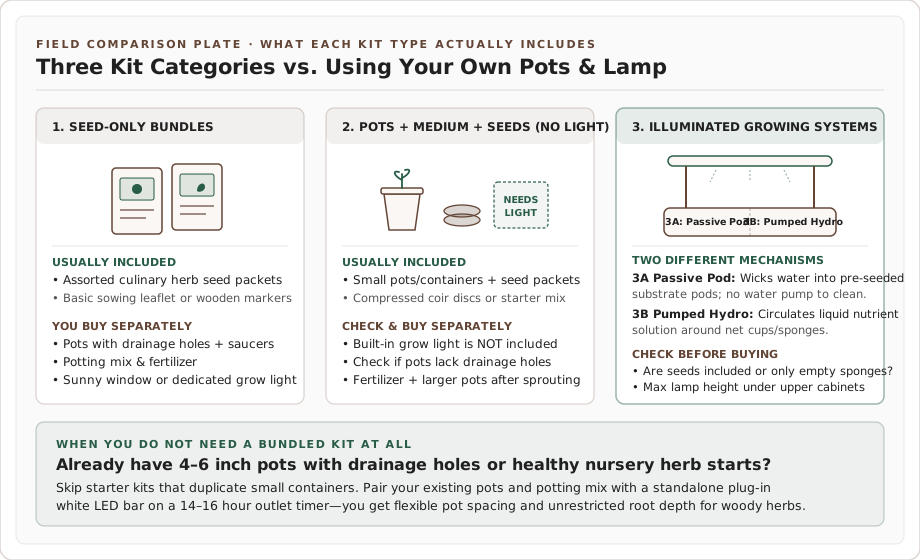
Before comparing prices, sort any product you are considering into one of three distinct equipment categories:
1. Seed-only bundles
These boxes contain an assortment of culinary herb seed packets (such as basil, parsley, cilantro, chives, thyme, and oregano) and sometimes wooden plant labels or a brief sowing leaflet. What is not included: pots with drainage holes, saucers, seed-starting or potting mix, fertilizer, and lighting. Seed bundles only make sense if you already own containers, potting mix, and a bright windowsill or grow light.
2. Pots + seeds + growing-medium starter kits without lighting
Often sold as “windowsill herb starter kits,” these bundle small pots, biodegradable fiber cups, or decorative tins with compressed coconut-coir discs and seed packets. What is not included: an overhead grow light. Many starter containers also lack drainage holes or are too shallow for long-term root growth, meaning you must supply strong natural window sun (or a separate lamp), liquid plant food once true leaves appear, and larger 4-to-6-inch drainage pots for transplanting.
3. Illuminated countertop growing systems (two different watering designs)
Illuminated units combine a water reservoir base, plant pod slots, and an overhead LED grow light on an automatic daily timer. However, illuminated systems are split into two very different mechanical designs:
- 3A. Passive substrate-based pod systems: Plants grow in stabilized, pre-fertilized solid substrate pods (such as Click & Grow Smart Soil pods). A capillary wick draws plain water passively from the bottom tank into each pod. There is no electric water pump, no moving water noise, and no liquid nutrient mixing during the life of the pod.
- 3B. Pumped hydroponic systems: Plants sit in small net cups with unfertilized peat or coir sponges suspended over a liquid nutrient tank. A motorized circulation pump or aerator moves water and dissolved fertilizer around the bare roots. These systems can grow herbs rapidly in water culture, but they require periodic liquid nutrient dosing, reservoir rinsing, pump cleaning, and checking whether the box includes pre-seeded pods or only blank sponges.
Included-versus-extra comparison matrix
Products within the same category do not always include identical components. Use this matrix to verify every line item on a product listing before ordering:
| Component / Requirement | 1. Seed-Only Bundle | 2. Unlit Pots + Medium + Seeds Kit | 3A. Illuminated Passive-Pod System | 3B. Illuminated Pumped Hydroponic System |
|---|---|---|---|---|
| Seeds | Included (multiple seed packets) | Usually included (check variety list) | Often included inside starter pods (verify count & herb type) | Varies widely—many units ship with empty sponges only; check listing |
| Growing medium | Extra (buy potting or seed-starting mix) | Included (compressed coir discs or starter pellets) | Included (stabilized wicking substrate pods) | Included (rooting sponges & net baskets) |
| Containers / drainage or reservoir | Extra (buy pots with drainage holes + saucers) | Small starter pots included (check whether drainage holes & tray exist) | Included (passive capillary reservoir base + wicks + float indicator) | Included (liquid tank + circulation pump or bubbler deck) |
| Lighting | Extra (bright window or standalone grow light) | Extra—no lamp in box; needs strong window sun or separate LED | Included (overhead white LED bar on mast or extension arms) | Included (overhead LED hood on telescoping or fixed post) |
| Nutrients | Extra (buy container herb fertilizer) | Usually extra once seedlings develop true leaves (coir has little nutrition) | Included inside pre-dosed substrate pods for the pod’s life cycle | Starter bottle often included; verify if A/B liquid nutrients come in box |
| Power & timer | None (unless adding a grow light + timer) | None (unless adding a grow light + timer) | AC power cord + automatic light timer (no pump power draw) | AC power adapter running both the LED hood and water pump |
| Replacement supplies | Standard seed packets & potting mix | Standard potting mix, seeds & larger pots | Brand-compatible pre-seeded or seedless substrate refill pods + replacement wicks | Compatible grow sponges, liquid hydroponic nutrients & net cups |
| Eventual repotting | Can sow directly in 4–6 in. final pots | Usually required—small starter cups dry out fast as roots fill them | Replace spent pods after several months or transplant root plugs into 4–6 in. pots | Water-grown roots can be potted into soil with care, or restarted with fresh sponges |
Six practical checks before you buy any indoor herb kit
-
1. Measure counter footprint, maximum lamp height, and refilling access
Standard US kitchen wall cabinets are often mounted roughly 18 inches above the countertop. An illuminated unit with extension arms or a telescoping light post may reach 17 to 19+ inches at full height—and you still need a few extra inches above or beside the unit to pour water into the fill port and trim tall basil stems. Measure width, depth, under-cabinet clearance, and cord reach to a dry grounded outlet before ordering.
-
2. Confirm whether seeds are actually included—not just empty pods or sponges
Read the “What’s in the box” section carefully. Some passive-pod systems include a starter pack of pre-seeded basil pods, whereas many pumped hydroponic units ship only with blank peat sponges, plastic domes, and net baskets, requiring you to buy herb seeds separately.
-
3. Check actual light provision: “indoor” does not mean suitable for a dark room
As University of Minnesota Extension notes, culinary herbs need strong light intensity and 14 to 16 hours of daily light under artificial fixtures when natural sunlight is limited. An unlit windowsill kit placed on an interior kitchen island or north-facing counter will produce pale, stretched stems. If your counter lacks bright sun, either choose an illuminated system or see our dedicated guide on indoor herb grow lights for leggy kitchen herbs in winter.
-
4. Compare real maintenance: watering, cleaning, pruning, and feeding
No indoor herb setup is maintenance-free. Unlit starter pots require frequent top-watering checks and careful drainage so soggy potting mix does not invite houseplant fungus gnats. Passive pod units simplify feeding and run silently without a pump, but you must still top up the water tank, wipe occasional mineral or algae buildup, and pinch fast-growing stems before leaves press against the warm LED bar. Pumped hydroponic units additionally require measuring liquid nutrients, draining and scrubbing the tank between crops, and cleaning roots out of the pump intake.
-
5. Check replacement pod compatibility and recurring supply costs
Before locking into an illuminated pod unit, check how much replacement pods cost and whether the brand sells “experimental” or seedless refill pods that let you sow your own standard seed packets. Proprietary pre-seeded pods are convenient for beginners, while seedless refill sponges lower long-term cost and let you choose any compact herb variety.
-
6. Set realistic herb yield expectations
A compact 3-pod countertop garden holds three small plants—ideal for snipping fresh basil leaves onto pasta, garnishing soups with parsley, or trimming chives a few times a week (UMN Extension: Growing Herbs). It will not produce unlimited bulk harvests or replace grocery-store bunches if you make big batches of pesto every week.
Which option to choose—and when existing pots plus a grow light are enough
- Choose a seed-only bundle only if you already have 4-to-6-inch pots with drainage holes, fresh potting mix, and either a sunny south/southwest window or an existing grow light.
- Choose an unlit pot + medium + seed starter kit only if you want a tidy giftable seed-starting bundle for a genuinely bright window and plan to pot the seedlings up into larger drainage containers once they establish.
- Choose an illuminated passive-pod system if your kitchen counter has poor natural light and you want a quiet, pump-free, small-footprint unit with built-in 16-hour lighting and pre-fertilized starter pods.
- Choose an illuminated pumped hydroponic unit if you want faster water-culture growth across more pod slots and do not mind mixing liquid nutrients and cleaning a reservoir and pump.
- Skip buying a kit altogether if you already own 4-to-6-inch drainage pots or prefer buying established potted rosemary, thyme, or mint starts at a local nursery. Pairing your own pots with a simple plug-in white LED bar on a timer gives woody and deep-rooted herbs much more root room than small countertop pods (and you can add a passive vacation watering setup later if you travel).
Click & Grow Smart Garden 3 (White, with 3 Basil Plant Pods)
Who this option suits: Beginners with a dim kitchen counter who want a compact 3-pod passive substrate system that includes an overhead 8W LED light (built-in 16-hour on / 8-hour off cycle) and 3 pre-seeded basil pods in the box, with no electric water pump or liquid nutrient mixing required (Click & Grow product docs).
Verified dimensions & practical limitations: Manufacturer specifications list a footprint of 11.8 × 4.7 inches (300 × 120 mm), a height of 8.25 to 18.5 inches (210 to 470 mm) with the included lamp extension arms, and a 75-inch (1900 mm) power cord (Click & Grow Support specs). Note that manufacturer pages state conflicting water reservoir capacity figures across product and support pages, so rely on the physical water-level float indicator rather than a fixed liter number. Holds 3 pods for fresh garnishes rather than bulk harvests, and uses compatible refill pods after each crop cycle.
Indoor Herb Kit: Included or Extra?
Includes the Included-vs-Extra comparison worksheet, counter and under-cabinet measurement log, and replacement-supply checklist. Free direct download with zero affiliate links inside the PDF.
Common first-time buying mistakes to avoid
- Assuming “indoor herb kit” means it includes a grow light: Always check whether an overhead LED bar is actually in the box.
- Placing an illuminated unit under low cabinets without measuring: Check that you have at least 18.5+ inches of vertical clearance as herbs grow and lamp extension arms are added.
- Crowding tall and compact herbs without pruning: Fast-growing basil can shade out slow-germinating thyme or parsley unless you pinch stems regularly above a leaf node.
- Overlooking seed and refill details: Confirm whether seeds come in the box and what replacement pods or sponges cost before buying.
Frequently asked questions
Does an "indoor herb kit" work in a room with no windows?
Only if the kit includes an overhead grow light (or you add one separately). Unlit pot-and-seed starter kits rely entirely on your home’s natural light and will produce weak, leggy seedlings in a dark room.
What is the difference between a passive pod system and a pumped hydroponic herb kit?
A passive pod system uses a capillary wick to draw plain water from a quiet reservoir into pre-seeded, pre-fertilized solid substrate pods without a water pump. A pumped hydroponic system suspends sponges in liquid water and uses a motorized pump or aerator, requiring periodic liquid nutrient dosing and pump cleaning.
Can I keep herbs in a compact pod unit forever, or do they need repotting?
Fast-growing annuals like basil and cilantro eventually outgrow small pods or become woody after several weeks to a few months. You can either start fresh pods or transplant vigorous plants into larger 4-to-6-inch drainage pots with potting mix.
When should I skip buying a kit and use my own pots instead?
If you already own 4-to-6-inch pots with drainage holes and potting mix—or want to buy established potted herb starts from a garden center—you usually only need a simple plug-in white LED grow light and an outlet timer rather than an all-in-one kit.
Sources & documentation references
- University of Minnesota Extension — Lighting for indoor plants and starting seeds
- University of Minnesota Extension — Growing herbs indoors and outdoors
- Click & Grow — The Smart Garden 3 Product Documentation
- Click & Grow Support — Smart Garden 3 specifications