Why Fungus Gnats Keep Coming Back to Houseplants (Even With Sticky Traps)
Yellow sticky traps catch flying adult fungus gnats, not the eggs, larvae, and pupae developing in damp potting mix. Here is how to confirm the source, adjust moisture safely for your plant, and track whether the population is actually declining.
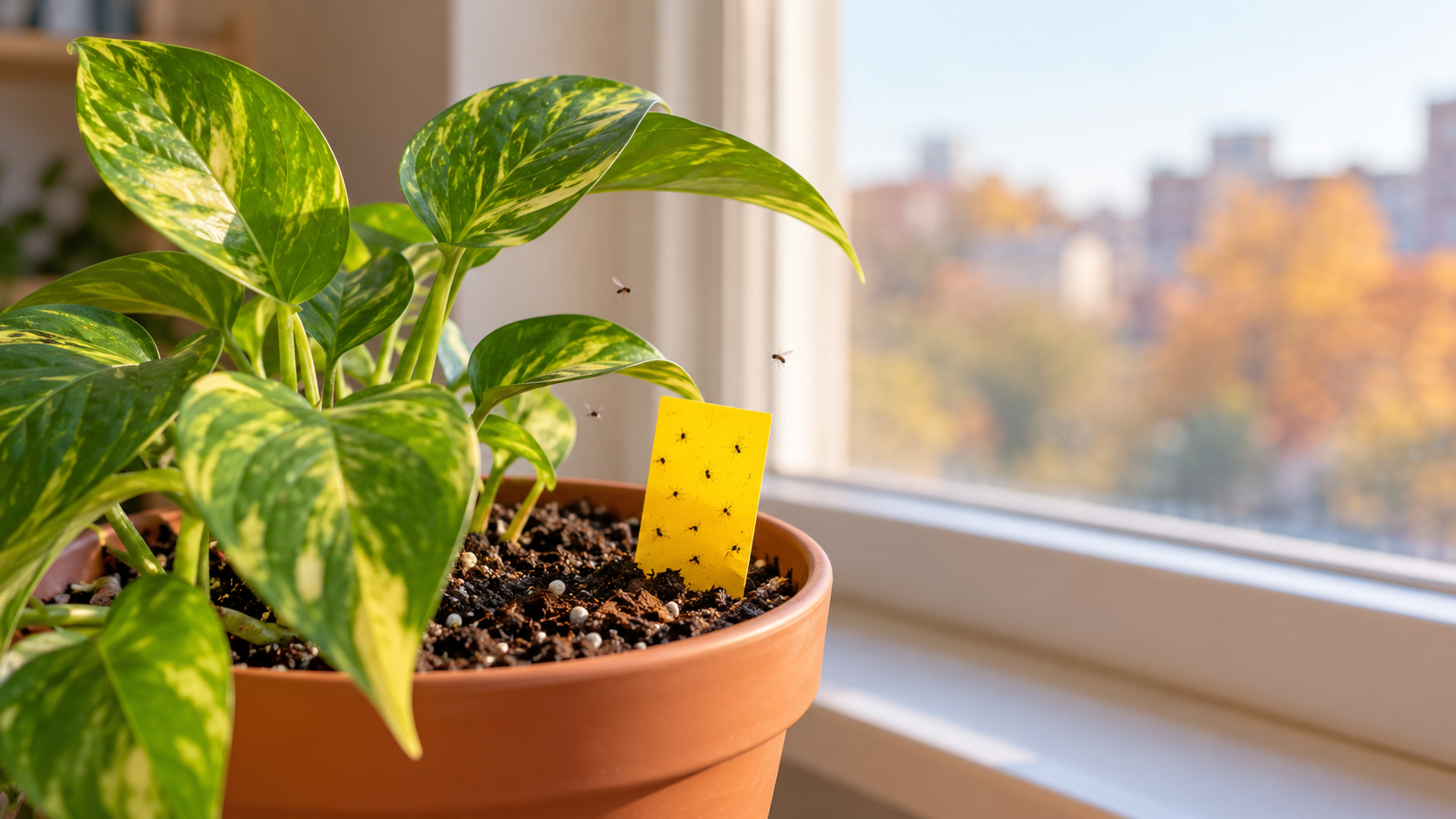
If tiny flies keep returning around your houseplants even though your yellow sticky traps are catching them, the traps may be working—but only on part of the problem. They catch adult fungus gnats. Eggs, larvae, and pupae can remain in moist potting mix, allowing new adults to emerge. To break the cycle, confirm the insect, address persistently damp potting soil without harming your plant, and use a larvae-targeting treatment when appropriate.
This guide is for people growing plants in indoor pots, from a few windowsill plants to a larger houseplant collection. Most fungus gnats are a nuisance rather than a serious threat to established houseplants. Severe infestations can harm roots, particularly in vulnerable plants, but an occasional adult fly does not mean your plant is dying. University of Minnesota Extension and UC Integrated Pest Management explain these differences.
First, make sure they really are fungus gnats
Adult fungus gnats are tiny, slender, dark flies, about 1/16–1/8 inch (roughly 1.5–3 mm) long, often seen walking over potting soil or flying around nearby windows. They can be mistaken for fruit flies. If the insects cluster around ripening fruit, food waste, or kitchen drains rather than the potting mix, do not automatically treat your plants. Indoor drains can also harbor small flies, and the source needs to be identified before treatment.
Look at which pot the flies emerge from when you gently disturb the soil. A yellow sticky card placed near the soil surface can help you monitor the adults. To investigate larvae, University of Minnesota Extension suggests placing a slice of potato on the potting soil and checking it periodically for small, legless larvae with dark heads. Remove the potato after inspecting it; do not leave rotting food in the pot. If insects do not seem connected to your pots, investigate other damp organic areas and drains. UMN Extension; University of Maryland Extension.
Why yellow sticky traps do not finish the job
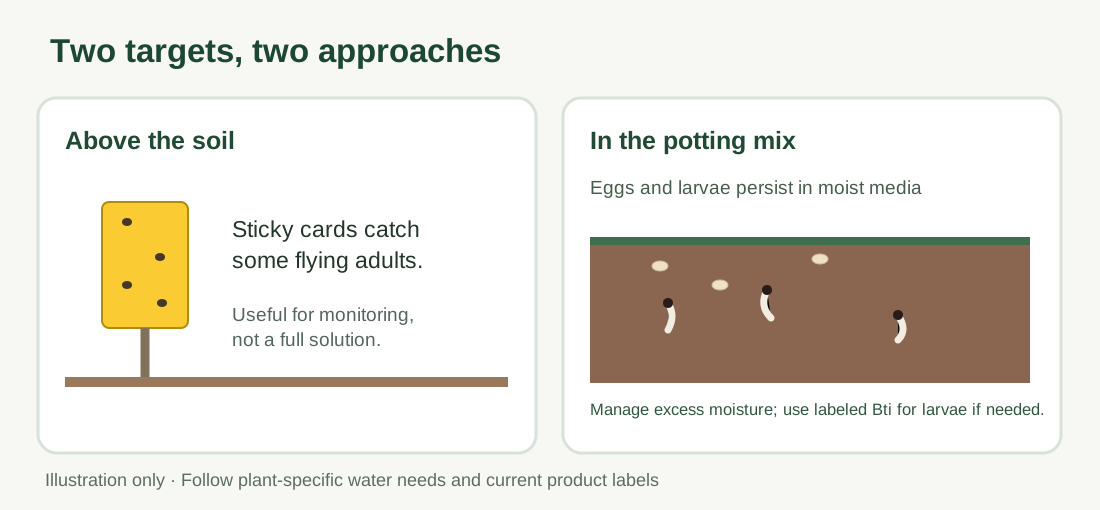
A sticky card catches some flying adults, which is useful for reducing nuisance insects and noticing whether activity is rising or falling. But the earlier life stages develop in damp organic media. A pot can therefore produce new adults while you are still catching the previous ones. Wisconsin Extension notes that eggs, larvae, pupae, and adults can overlap indoors. That is why a single clean-looking day is not reliable proof that the infestation is gone. Wisconsin Horticulture.
The key distinction is straightforward: sticky traps target flying adults; changes to growing conditions and suitable biological controls target the breeding environment or larvae. Neither strategy replaces the other. You can keep a trap in the pot while taking action in the potting mix.
A practical plan to stop recurring fungus gnats
-
01
1. Check every nearby pot, not just the busiest trap
Set a trap near the surface of a suspect pot and check adjacent plants for the same insects. One especially damp pot can keep contributing adult flies. Inspect saucers and decorative cachepots for standing water, and remove dead leaves and decaying material from the soil surface. If plants have recently been moved indoors from a patio, inspect those closely too; fall is a common time for these pests to become noticeable indoors. UC IPM; Wisconsin Horticulture.
-
02
2. Adjust moisture carefully for the plant you actually own
Fungus gnats favor persistently moist potting soil. Before watering, check the mix rather than relying on a fixed number of days. Where the species tolerates it, allow the upper surface to dry between waterings. Wisconsin Extension describes drying roughly the top inch of soil as one possible tactic for suitable houseplants. But that is not a universal instruction: moisture-loving plants, small rooted cuttings, and plants with delicate root systems may not tolerate the same degree of drying as drought-tolerant species.
When the plant does need water, water it appropriately and let surplus water drain. Empty collected water rather than allowing the pot to remain submerged unintentionally. A pot without a drainage outlet or a dense, slow-draining mix may remain wet for too long even if you water infrequently. For a persistently waterlogged plant, address the container or potting mix rather than simply ignoring a stressed plant’s water needs. UMN Extension; UC IPM.
-
03
3. Keep the sticky traps as a monitor
Place yellow sticky cards near affected pots where they will not stick to leaves, pets, or people. Check them regularly and replace cards when dirty or full. Compare activity over time using similar card placement. Counts from different cards or exposure periods are not directly comparable, so record when each card was installed. The goal is a sustained downward trend, not a claim that a single day’s catch measures the entire population.
-
04
4. If needed, target larvae with an appropriately labeled Bti product
Bacillus thuringiensis subsp. israelensis (Bti) is a biological control used against fungus gnat larvae in growing media. It does not kill eggs, pupae, or adults, so control may require repeated treatments while newly hatched larvae become susceptible. Use only a product whose current label permits your intended indoor houseplant/soil use, follow its mixing, application, reapplication, and safety instructions exactly, and never improvise a dosage from an unrelated mosquito-water label. Do not assume every Bti product has identical directions or household-use permissions. Wisconsin Horticulture; UC IPM.
For a minor infestation, fixing the persistent moisture problem and monitoring may be sufficient. Avoid indoor fogging or routine sprays aimed at flies in the air; UC IPM says insecticides are rarely warranted for fungus gnats around homes. UC IPM.
-
05
5. Give the changes time and keep observing
Do not expect every adult to vanish immediately. Different life stages coexist in the pot, and adults may keep appearing temporarily while management takes effect. Wisconsin Extension notes that three to four weeks of modified watering and surface practices may be needed to bring gnats under control. That is a general expectation, not a guaranteed deadline. Keep watching trap activity, plant vigor, and soil conditions; reconsider your diagnosis if the flies persist without a clear soil source. Wisconsin Horticulture.
Troubleshooting: what the signs suggest
| What you notice | Likely explanation | Practical next move |
|---|---|---|
| Traps fill up, but new flies still appear | Traps catch adults while immature stages remain in the mix | Correct excess moisture and consider a labeled larvae-targeting treatment |
| One pot stays soggy for days | Poor drainage, dense mix, or excessive watering may maintain breeding conditions | Check drainage, saucer water, pot size, and mix suitability |
| Flies cluster near the kitchen sink, not plants | Another breeding source may be involved | Investigate drains and food-waste areas before treating soil |
| Leaves wilt while the pot feels wet | Possible root or watering problem; insects alone may not explain it | Inspect growing conditions and root health; do not keep adding water reflexively |
| You see only a few flies after treatment | Adults may still emerge from other life stages or nearby pots | Monitor consistently and check neighboring containers |
These are diagnostic clues, not definitive identifications. If the plant is declining quickly, look for other causes of wilting or root damage in addition to possible gnats.
Do you need to repot?
Not automatically. Start with identifying the pest, improving the watering and drainage situation, and monitoring. Repotting can be useful if the potting medium remains persistently wet, the container is unsuitable, or the infestation cannot be managed through ordinary care. Use fresh, appropriate potting mix and a clean pot; handle roots gently. Repotting is a larger intervention and can stress plants, so it should match the plant’s condition rather than be a universal first step. University of Minnesota Extension lists fresh soil and a clean container as a possible management measure. UMN Extension.
What you need—and what you probably do not
A way to assess soil moisture, a pot with functional drainage, clean saucers, and a yellow sticky card may be all you need to begin. A suitable Bti treatment is optional for persistent larvae problems, provided the exact product’s label authorizes the planned use. Avoid buying an assortment of sprays before identifying the insect and its breeding site. Do not assume any particular brand is necessary.
Fungus Gnat Troubleshooting & Monitoring Sheet (PDF)
Includes source identification checks, a 6-row sticky-card and soil-moisture monitoring log, a 3–4 week decision check, and university extension references.
Frequently asked questions
Do yellow sticky traps kill fungus gnat larvae?
No. They catch flying adults, not larvae feeding in moist potting mix. Continue using them to monitor while you address the breeding conditions.
Should I let every houseplant’s soil dry completely?
No. Adjust watering to the species and growing conditions. The goal is to prevent unnecessary, prolonged wetness without damaging roots that need consistent moisture.
Will fungus gnats kill my mature houseplant?
Usually not. They are generally a nuisance to established indoor plants, although high larval numbers can injure roots and stressed or young plants can be more vulnerable. Investigate plant decline rather than assuming the flies are the sole cause.
How long until the flies are gone?
Expect gradual improvement rather than instant elimination. Depending on conditions and treatment, managing overlapping generations can take weeks. A consistent downward trend in new catches is more useful than an arbitrary deadline.
Do I need to treat every plant?
Inspect nearby pots and target the ones actually contributing to the problem. Avoid unnecessary treatments of unaffected plants, especially when a product label does not support that use.
The bottom line
If fungus gnats keep returning, a trap is not necessarily failing: it may be catching adults while a damp pot continues to produce more. Confirm the source, check drainage and watering for the specific plant, use traps to monitor, and reserve labeled larvae control for situations that need it. Consistent, plant-appropriate care is more useful than chasing every adult fly.
Sources
- University of Minnesota Extension — Managing insects on indoor plants
- University of Wisconsin–Madison Extension — Fungus Gnats on Houseplants
- University of California Integrated Pest Management — Fungus Gnats
- University of Maryland Extension — Fungus Gnats (updated July 2, 2026)