
What “self-watering” actually means indoors
Two pots can look the same outside—and give your roots very different growing conditions. When shopping for self-watering pots for indoor plants, the most important thing to understand is that “self-watering” simply means stored water delivered gradually from a reservoir through a capillary system. It does not mean zero monitoring, zero maintenance, or automatic protection against root rot.
Choosing well starts with your plant’s root-zone moisture habits and the internal engineering hidden inside the outer shell—not the pot’s color or exterior silhouette (University of Maryland Extension: Watering Indoor Plants).
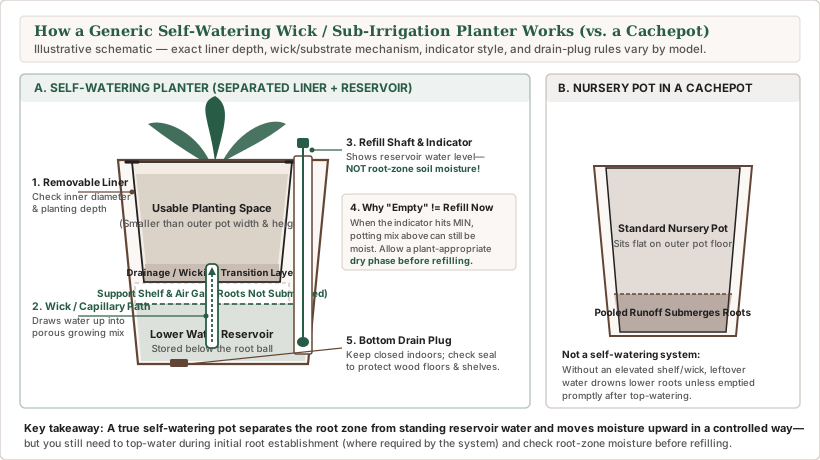
How wick and sub-irrigation systems work vs. a nursery pot in a cachepot
True self-watering containers—also called sub-irrigation planters—use capillary action to move water upward from a lower storage tank into the growing medium as the root zone dries (University of Maryland Extension: Self-Watering Containers; note that UMD’s container guide includes outdoor vegetable examples, so use it to understand the capillary sub-irrigation mechanism rather than as a universal indoor houseplant watering schedule).
1. Cord-wick reservoir planters
An inner liner sits on a support rim above a bottom water basin. A braided cotton, nylon, or microfiber wick extends from the bottom of the potting medium down into the water, pulling moisture upward by capillary attraction while the root ball itself stays suspended above the liquid line.
2. Mineral-bridge or separator-deck sub-irrigation systems
Instead of a fabric cord, a slotted separator base holds a shallow layer of porous mineral granules (such as pumice, zeolite, and lava in LECHUZA sub-irrigation planters) or molded capillary columns that contact the reservoir below and transfer moisture into the potting layer above once roots have grown down toward the separator.
3. What a cachepot is (and why it is different)
An ordinary plastic nursery pot placed inside a decorative outer cachepot has no raised capillary separator. If excess water pools in the bottom of a cachepot after top-watering, the lower inch of potting mix sits directly submerged in stagnant water, driving out oxygen and accelerating root decay (UMD Extension).
Start with your plant’s moisture profile—not a universal plant list
No self-watering pot is universally right or wrong for every houseplant. Even two plants of the same species dry out at very different speeds depending on window light intensity, room temperature, winter heating, leaf canopy size, and potting medium porosity (UMD Extension: Watering Indoor Plants).
- Plants that prefer consistent, even moisture: Tropical foliage plants that suffer when their root ball dries completely—provided they sit in bright light and an airy substrate—often adapt well to capillary reservoirs, so long as you still allow brief aeration intervals between refills.
- Why plants needing substantial drying between waterings require extra caution: Succulents, cacti, ZZ plants, snake plants, epiphytic orchids, and plants resting in dim winter corners need extended dry periods where air fills the pore spaces around their roots. If you keep refilling a reservoir whenever the float drops, capillary action keeps the lower medium continuously damp, starving drought-adapted roots of oxygen.
Usable inner-pot dimensions vs. outside dimensions
One of the most common online buying surprises is ordering an “8.5-inch self-watering pot” for an 8-inch nursery plant—only to discover the plant will not fit inside. Because a self-watering planter houses a lower water tank, a support shelf, a refill shaft, and double walls, the usable inner planting space is always smaller than the exterior shell.
Similarly, a larger reservoir volume does not mean more root space—often, a deep bottom tank reduces the vertical planting depth left for your root ball. Always measure your plant’s current nursery pot diameter and root-ball height, then check four separate numbers on the product spec sheet:
- Outer diameter and height (to confirm shelf or windowsill fit).
- Usable inner liner diameter (the actual opening your root ball must fit into).
- Usable planting depth above the separator or wick deck.
- Planting volume vs. reservoir volume (never confuse soil capacity with water capacity).
Reservoir engineering: refill access, indicators, inserts, and indoor leak protection
- Why the water-level indicator does not measure soil moisture: A float gauge only tells you whether liquid water is sitting in the bottom reservoir. When the indicator drops to “Min” or “Empty,” the potting mix around the roots frequently remains moist for days (LECHUZA FAQ). Always wait through a dry phase and check the root zone with your finger or a wooden probe before adding water.
- Refill access vs. lifting the plant: Look for a dedicated vertical refill shaft or wide side fill lip so you can pour water directly into the reservoir without splashing foliage or lifting a heavy planted insert out of the outer pot every week.
- Removable inner liners and cleaning: A removable inner liner with sturdy handles makes repotting, flushing excess fertilizer salts at the sink, and scrubbing biofilm or algae from the outer basin far easier than one-piece pots with snap-in false bottoms.
- Replacement wicks, floats, and drain plugs: Synthetic wicks can clog with mineral crust or fine roots over time, and clear indicator tubes can get bumped during cleaning. Check whether the pot uses standard braided wick cord or brand-available replacement parts.
- Indoor leak protection & drain-plug rules: Indoor/outdoor sub-irrigation planters include a removable bottom drain plug (or screw) so rainwater can escape outdoors. For indoor use, verify that the bottom drain plug is firmly closed and sealed, and place a protective pad under pots sitting on finished wood floors or furniture (LECHUZA Sub-Irrigation Documentation).
Growing media and the initial top-watering establishment phase
Sub-irrigation changes how air and water share pore space in a container. Heavy garden soil or dense, decomposed peat mixes hold too much water and too little air when wicked continuously from below, creating a prime breeding ground for indoor houseplant fungus gnats and root rot.
There is no single universal substrate recipe or drying interval for all indoor plants. Instead, match a well-aerated container medium (or the mineral drainage layer specified by your planter’s manufacturer) to your plant’s root structure. Just as importantly, check whether your system requires an initial top-watering establishment phase: in separator-deck systems like LECHUZA, newly potted plants must be watered gently from above for the first several weeks until roots grow down toward the moisture zone before you fill the bottom reservoir (LECHUZA Sub-Irrigation System).
Ongoing maintenance, realistic refilling, and when a standard pot is enough
Ignore marketing claims that promise a fixed number of unattended days (“waters your plant for 14 or 30 days!”). How fast a reservoir empties depends on plant size, leaf area, room humidity, season, and window sun. If you hope to use a self-watering pot for travel, set it up and observe it at home for several watering cycles before leaving (or compare dedicated pre-trip setups in our guide to choosing a vacation watering system for indoor pots). Over months of sub-irrigation, dissolved minerals also rise toward the top of the medium; periodically flush the inner liner from above at a sink and rinse the outer reservoir.
When keeping your existing drainage pot is enough: If you own only a few forgiving houseplants, prefer plants that need thorough drying between waterings, or simply need a consistent habit of checking soil 1 to 2 inches deep before watering into a saucer and emptying the excess after 15–30 minutes, a standard pot with drainage holes is simpler, cheaper, and easier to inspect (UMD Extension).
Check before buying: self-watering pot evaluation table
Use this table to compare any indoor self-watering planter before adding it to your cart:
| Feature | What to check | Why it matters |
|---|---|---|
| Plant moisture profile | Does the plant prefer even moisture or substantial drying between waterings? | Drought-adapted plants risk root rot if a reservoir is refilled before the root zone dries and re-aerates. |
| Usable inner diameter & depth | Inner liner width and vertical planting depth vs. outer decorative shell dimensions. | Reservoir tanks and double walls reduce root space; an 8.5 in. outer pot may have only a 7.25 in. inner opening and 5.3 in. depth. |
| Planting volume vs. reservoir volume | Separate liter/quart specs for soil capacity (e.g., 3 L) and water storage (e.g., 0.8 L). | A large water tank does not mean more room for roots, and reservoir size alone never guarantees a fixed number of unattended days. |
| Refill access & removable liner | Dedicated fill shaft or side port plus a lift-out inner liner with handles. | Lets you refill without wetting leaves or lifting the plant, and makes sink flushing and reservoir cleaning practical. |
| Water-level indicator | Float gauge visibility (Min/Max) and protective tube assembly. | Shows reservoir water level only—never root-zone moisture. Helps you wait until the tank hits Min before starting a dry phase. |
| Growing medium & establishment | Whether mineral drainage granules or wicks are included, and initial top-watering rules. | Dense soil suffocates roots; many sub-irrigation pots require top-watering for weeks until roots reach the moisture zone. |
| Indoor leak protection & parts | Bottom drain plug seal for indoor use and availability of replacement wicks/gauges. | Prevents water leaks onto indoor furniture and ensures the pot stays usable if a wick clogs or a float cap is lost. |
Buyer worksheet: six fields to record before ordering
Fill in these six checks on paper (or in the printable PDF below) for each houseplant you plan to repot:
- 1. Plant type & moisture preference
- Species, window light level, and whether it prefers even moisture or thorough drying between waterings.
- 2. Current root-ball dimensions
- Current nursery pot top diameter (in/cm) and root-ball height from base to soil line.
- 3. Usable planting space
- Candidate pot’s inner liner diameter, planting depth above separator, planting volume (L), and reservoir volume (L).
- 4. Reservoir access & indoor seal
- Dedicated refill shaft vs. lifting liner, removable insert handle, and bottom drain plug status for indoor surfaces.
- 5. Substrate & establishment requirements
- Included mineral drainage layer or wick medium needs, plus initial top-watering duration before filling reservoir.
- 6. Replacement parts & cleaning access
- Wick or indicator gauge replacement availability and how easily the inner liner lifts out for periodic salt flushing.
As an Amazon Associate I earn from qualifying purchases.
LECHUZA 16020 Classico LS 21 Self-Watering Planter, White High Gloss
Why this design illustrates key check-before-buying features: Unlike sealed one-piece pots, the Classico LS 21 pairs an outer shell with a removable color-coordinated inner liner and recessed carrying handle, a dedicated refill shaft, a water-level float indicator, a starter pouch of LECHUZA-PON mineral substrate for the capillary drainage layer, and a bottom drain plug that stays closed for indoor use (LECHUZA Sub-Irrigation Documentation).
Verified Classico LS 21 specifications & limitations: Outer dimensions are approximately Ø 22 × 20 cm (8.5 × 8 in.), while the removable inner liner has a usable diameter of approximately 18.5 cm (7.25 in.) and a planting depth of 13.5 cm (5.3 in.). Planting volume is 3 liters and water reservoir capacity is 0.8 liters (do not confuse reservoir volume with soil volume, and note that Classico Color or non-LS models do not all include the removable LS liner). Requires initial top-watering while roots grow down to the separator and a dry phase after the indicator reaches Min.
Self-Watering Pot Buying Checklist
Includes the 6-field buyer worksheet, inner-vs-outer dimension log, and setup-monitoring checklist. Free direct download with zero affiliate links inside the PDF.
Frequently asked questions
What is the difference between a self-watering pot and a nursery pot inside a decorative cachepot?
A self-watering pot suspends the planting liner above a dedicated lower water reservoir—leaving a support platform and air space—and moves water upward in a controlled way through a cotton/nylon wick or a capillary mineral layer. A standard nursery pot sitting flat inside a non-draining cachepot has no separation shelf or metered wicking path; any excess water pools directly around the bottom of the pot and submerges the lower roots unless you pour it out.
When the water-level indicator reaches MIN, should I refill the reservoir right away?
Usually no. The indicator measures water remaining in the bottom reservoir, not moisture inside the root ball. Even when the reservoir is empty, the potting medium above still holds moisture. Most sub-irrigation systems (including LECHUZA) recommend waiting through a "dry phase" of several days—adjusted for your specific plant, pot size, and room conditions—so roots receive oxygen before you refill.
Why do some self-watering planters require top-watering for the first few weeks?
In sub-irrigation planters that rely on roots growing toward a mineral wicking layer at the base of the liner, newly repotted plants have not yet extended roots deep enough to draw water from the reservoir. Watering lightly from above during this initial establishment phase keeps the upper root ball moist until roots reach the sub-irrigation zone.
Can a self-watering pot cause root rot or fungus gnats?
Yes, if the reservoir is refilled continuously without a dry phase, if the potting mix is too dense and peat-heavy to hold air, or if water is filled past the maximum line so the root zone stays waterlogged. Continuously damp upper potting mix can also attract fungus gnats.
When is keeping my existing drainage pot better than buying a self-watering planter?
If your houseplant is already thriving in a standard pot with drainage holes and a saucer, if you grow plants that prefer thorough drying between waterings, or if you only have a few easy-care pots and can check soil moisture with your finger once a week, improving your watering habits in your existing pots is often all you need.
Sources & documentation references
- University of Maryland Extension — Watering Indoor Plants
- University of Maryland Extension — Self-Watering Containers (Sub-Irrigation Mechanism Reference)
- LECHUZA — The LECHUZA Sub-Irrigation System Documentation
- LECHUZA — Frequently Asked Questions: Water-Level Indicator, Dry Phases & Drain Plugs