
1. Immediate answer: does beer belong in succulent soil?
Do not pour beer into succulent pots as a plant-care treatment. The horticultural sources consulted for this guide (Iowa State University Extension, University of Minnesota Extension, University of Florida IFAS, UC ANR, and the Royal Horticultural Society) do not establish beer as an effective way to loosen compacted potting soil, restore shriveled or yellowing leaves, improve root health, or fertilize succulents.
Where does the gardening association with beer come from? In outdoor vegetable and flower beds, stale beer is sometimes poured into a sunken container trap to attract and drown slugs (University of Vermont Extension). That is a separate pest-trapping application—not evidence that pouring beer into a houseplant pot benefits plant roots or potting soil.
Evidence limitation & balanced perspective: The circulating social-media screenshot that sparked this question shows a hand pouring golden liquid from a can onto a potted succulent above the incomplete caption “beer can loosen the...”. Because the caption is cut off, the original video’s complete wording, recipe, and outcome are unknown. At the same time, there is no need for alarmism: a single splash of beer is not guaranteed to kill a succulent overnight or proven to cause one specific plant disease, but it offers no established benefit and adds unnecessary liquid and organic residue to a root zone that relies on fast drainage and air-filled pore space.
2. Identify the succulent: container-grown rosette care (and species differences)
The plant pictured in the viral clip is a compact, fleshy-leaved rosette succulent that resembles an Echeveria, one of the most widely sold indoor and patio rosette genera (Royal Horticultural Society). Because a single screenshot cannot verify the exact species, hybrid, or cultivar—and look-alike rosettes include Graptopetalum, Graptoveria, Sempervivum, and Aeonium—treat visual identification from a social clip as approximate.
The guidance below focuses on container-grown rosette succulents such as Echeveria, which store water in thick leaves and require bright light, porous growing media, and thorough drying between waterings (UMN Extension; UC ANR). Always note that succulent genera vary in cold hardiness, seasonal dormancy, and sun tolerance.
3. Normal lower-leaf aging vs. a real plant problem
In the viral screenshot, a dry, browned leaf sits tucked beneath the bottom rim of an otherwise plump green rosette. Many beginners see a single crispy basal leaf and assume the plant is starving, diseased, or suffering from “locked-up” soil—making them vulnerable to quick-fix kitchen hacks.
As Iowa State University Extension explains, occasional drying and shriveling of the oldest bottom leaves is a normal part of succulent growth. As an Echeveria or similar rosette produces fresh leaves from its center crown, it gradually reabsorbs water and mobile nutrients from its lowest outer leaves until they turn thin, dry, and papery.
- Normal basal leaf turnover: Affects only 1 or 2 of the lowest outer leaves at a time; the leaf dries crisp and papery while the upper rosette and stem remain firm. Once the leaf is completely dry and releases easily, gently pluck or brush it away so debris does not collect on the soil surface.
- Warning signs that are NOT normal aging: Widespread yellowing across multiple tiers of leaves, leaves turning pale and translucent, a soft or mushy feel when gently pinched, sudden leaf drop when barely touched, or a darkened, soft stem base. Never diagnose a disease from a single dry lower leaf—always inspect the whole plant and potting mix first.
4. Overwatering vs. underwatering: how to tell overlapping symptoms apart
Both too much water and too little water can cause succulent leaves to lose firmness and discolor—and once severe root rot destroys a plant’s roots in soggy soil, the upper leaves can even wrinkle from dehydration because no healthy roots remain to take up water (Iowa State University Extension). Compare the leaf texture alongside the moisture inside the pot:
- Overwatering & poor drainage clues: Leaves look swollen, yellow, pale, or translucent and feel soft, squishy, or mushy; lower leaves may drop off at a light touch; the potting mix feels heavy, cool, and damp days after watering.
- Underwatering clues: Leaves look wrinkled, puckered, flat, or deflated (starting with lower and middle leaves) without turning translucent or mushy, and the potting mix is bone-dry and light all the way through the container.
- How to check moisture below the surface (the wooden chopstick check): Never judge moisture by the top quarter-inch of soil alone. Lift the pot to feel how heavy it is, and gently push a clean, plain wooden chopstick or wooden skewer 2 to 3 inches into the mix (away from the main stem) for 2 to 3 minutes. If the wood comes out dark, cool, or with damp soil crumbs clinging to it, the root zone still has moisture—do not water. Remember that no universal watering interval (like “once a week”) works for every home.
Succulent Symptom Checker (Non-Definitive Diagnostic Clues)
Use these observations together with a subsurface soil check rather than treating any single symptom in isolation:
| What you see | What it may mean | What to check next | Appropriate first action |
|---|---|---|---|
| A single dry lower leaf | Often normal aging and reabsorption of the oldest basal leaf as new center growth forms. | Check whether upper leaves and the center crown are plump and firm, and whether the stem base is solid. | Leave your watering routine unchanged; gently remove the dry papery leaf once it detaches easily. |
| Several soft, translucent leaves | Excess moisture in the root zone, poor drainage, or early root/stem rot. | Check subsurface moisture with a wooden chopstick, inspect the drain hole and saucer, and check the stem base for dark softness. | Stop watering immediately, empty any saucer/cachepot, move to bright airy light, and unpot to inspect roots if the mix stays soggy. |
| Wrinkled leaves with dry mix | Underwatering (the plant is drawing on stored leaf water in dry soil). | Confirm the pot feels feather-light and a wooden skewer comes out completely dry 2–3 inches down. | Water thoroughly with plain water until excess runs from the drainage hole, then empty the saucer after 10–15 minutes. |
| Wet mix that stays damp | Dense, water-retentive potting soil, an oversized container, a blocked drain hole, or cool/dim conditions. | Check if the pot has an open drain hole, whether water is trapped in an outer decorative pot, and how fine/peaty the soil looks. | Withhold water until dry; if the medium remains soggy for many days, repot into a porous cactus and succulent mix in a draining pot. |
| Stretched or flattened growth | Insufficient light (etiolation)—stem internodes lengthen and lower leaves angle downward to catch more light. | Evaluate window direction, distance from glass, shading from curtains/overhangs, and daily hours of bright light. | Move gradually over 1–2 weeks to a brighter window or supplemental grow light; note that already-stretched stem sections will not shrink back. |
| Sun-scorched patches | Leaf sunburn from an abrupt move into hot, direct sunlight (or intense reflection through glass). | Check whether bleached, beige, or brown scarred patches face the strongest sun exposure after a recent move. | Shift to bright filtered light and acclimate gradually over 1–2 weeks; scarred patches are permanent on affected leaves until outgrown. |
5. Root health and drainage: why porous medium and drain holes matter more than kitchen hacks
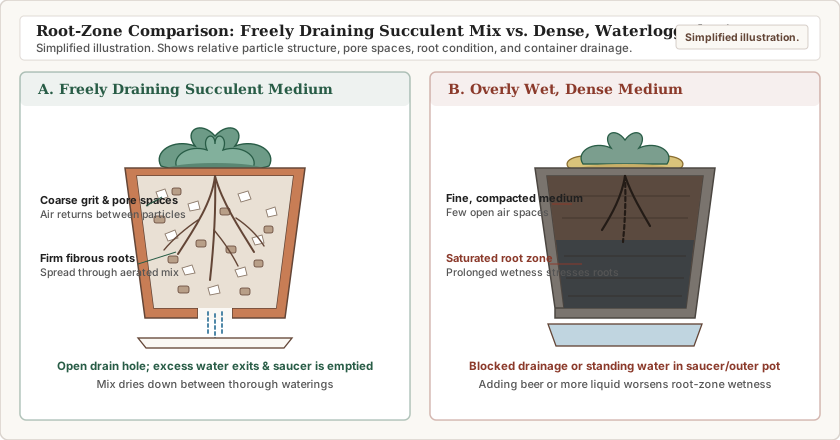
Succulent roots need oxygen in the pore spaces between soil particles just as much as they need occasional moisture. When a succulent sits in dense, fine-textured potting soil—or when water pools at the bottom of a container—water fills those pore spaces, limits root-zone oxygen, and encourages root-rotting organisms (UMN Extension; UF/IFAS).
That is why the incomplete viral phrase “beer can loosen the...” misses the mark on container physics. Pouring beer into a pot does not create coarse mineral pore spaces. Instead, healthy succulent root zones depend on two physical essentials:
- A porous cactus and succulent growing medium: Unlike heavy garden soil or standard moisture-retentive houseplant soil, a cactus and succulent mix incorporates coarse mineral grit, perlite, pumice, or aged bark particles so excess water drains rapidly and air returns around the roots (UC ANR; RHS).
- An unobstructed drainage hole and emptied saucer: Always grow succulents in a pot with at least one open bottom drainage hole. If you place a plastic nursery pot inside a decorative outer cachepot (see our guide to how container inserts and reservoirs affect root-zone drying), lift the inner pot out to water at the sink and let it finish draining before setting it back inside, and empty any saucer 10 to 15 minutes after watering.
6. How to water succulents properly (and why surface sprays fall short)
Extension horticulturists recommend the “soak and dry” approach for container succulents rather than frequent small sips (UMN Extension; UC ANR):
- Confirm the potting mix has dried down: Check 2 to 3 inches deep with a clean wooden chopstick and verify the pot feels light.
- Water thoroughly at the soil line: Pour plain room-temperature water over the potting medium (avoiding letting water sit trapped in the tight center rosette of Echeveria) until water flows freely out of the bottom drainage hole.
- Drain completely and wait: Empty the saucer after 10 to 15 minutes, then wait until the mix dries down again before the next watering.
Why tiny surface sprays or misting are not a substitute: Misting mature succulents or dribbling a spoonful of water onto the top crust wets only the upper fraction of an inch and leaves lower roots dry while encouraging shallow roots and damp stem bases (UC ANR). Always adjust your watering frequency for season, species, light level, pot size and material (porous unglazed terracotta dries faster than plastic or glazed ceramic), indoor temperature, and potting medium. During cool, short-day winter months, most indoor succulents grow slowly and need water far less often (RHS).
7. Light and plant position: preventing stretching and sunburn
Light directly governs both how compact a rosette stays and how quickly its pot dries (Iowa State University Extension; UMN Extension):
- Bright light for compact rosettes: Echeveria-type succulents need bright indoor light—typically a sunny south-, east-, or west-facing windowsill (or a dedicated white LED grow light positioned 6 to 12 inches above the foliage for 12 to 14 hours daily in dim rooms).
- Recognizing low-light stretching (etiolation): When light is too dim, the rosette flattens out, lower leaves bend downward, and the stem stretches into a pale, leggy stalk with wide gaps between leaves.
- Gradual acclimation to prevent sunburn: Never move a succulent straight from a dim living room table into blazing midday outdoor sun. Increase brighter sun exposure gradually over 1 to 2 weeks so the leaves build protective wax and pigments without scorching into permanent tan or bleached scars.
8. Common mistakes to avoid
- Pouring beer, soda, coffee, or kitchen scraps into succulent pots: Adds moisture, sugars, and fermentation residues that can sour the potting mix and attract indoor fungus gnats without loosening soil or feeding the plant.
- Watering on a rigid calendar schedule: Watering every Friday regardless of weather or season keeps dense soil wet in winter and stresses roots.
- Planting in containers without drainage holes (or leaving water in saucers): Glass bowls, sealed ceramic mugs, and unemptied cachepots trap water around the root zone.
- Assuming every dry brown bottom leaf is a disease: Panicking over normal basal leaf aging often leads to overwatering or unnecessary chemical treatments.
- Keeping rosette succulents in dim corners or moving them abruptly into harsh sun: Causes etiolation on one extreme or leaf sunburn on the other.
- Over-fertilizing (especially in winter): Succulents have modest nutrient needs; excess fertilizer salts burn roots and push weak, soft growth.
- Frequent, unnecessary repotting: Repeatedly unpotting a healthy succulent disturbs fine feeder roots; repot only when the medium is unsuitable, degraded, or waterlogged.
9. If someone already poured beer into a succulent pot: cautious triage steps
If you or a family member already tried the viral beer trick on a succulent, take a calm, practical approach based on how much liquid went in and how the pot drains—no step guarantees recovery if advanced stem rot was already present, but prompt triage prevents unnecessary root stress:
- Stop adding beer or any other household solutions: Stick strictly to plain water when the plant genuinely needs watering.
- Assess how much beer entered and check drainage: If only a small splash entered a pot that has an open drainage hole and porous cactus mix—and the plant looks firm and healthy—flush the potting mix once at the sink with plain room-temperature water, let it drain completely for 15 minutes, empty the saucer, and allow the mix to dry thoroughly in a bright, ventilated spot.
- Unpot and inspect roots if the soil is dense, sour, or staying wet: If a large amount of beer was poured into heavy, slow-drying soil, if the container has no drainage hole, if the pot smells sour, or if lower leaves are turning soft and translucent, gently ease the plant out of the pot and brush away the wet medium.
- Repot into fresh, porous succulent mix when warranted: Inspect the roots and stem base. If roots are firm and pale or tan, let the root ball air-dry on a paper towel out of direct sun for a day, then pot into fresh, dry cactus and succulent mix in a container with a drainage hole. If some roots are dark, mushy, and stringy, trim the decayed roots with clean shears and allow cut surfaces to dry briefly before potting into fresh porous mix—and wait several days before watering lightly.
Succulent Watering & Drainage Checklist (PDF)
Includes the quick leaf-symptom triage checklist, wooden-chopstick soil-moisture steps, pot and drainage inspection points, seasonal watering reminders, emergency beer/overwatering triage steps, and a write-in pot log. Free direct download—no email required and zero affiliate links inside the PDF.
10. Frequently asked questions
Is beer good fertilizer for succulents?
No. Consulted university Extension and Royal Horticultural Society guides do not recommend beer as a succulent fertilizer. Beer consists mostly of water, carbohydrates, yeast byproducts, and alcohol rather than balanced, plant-available mineral nutrients, and pouring it into a pot adds unnecessary moisture and organic residue to the root zone.
Can beer loosen compacted potting soil?
Horticultural sources do not establish beer as an effective way to loosen compacted container soil. Wetting dry potting mix with any liquid temporarily softens the surface, but lasting container aeration comes from physical particle structure—such as coarse mineral grit, perlite, pumice, or bark in a cactus and succulent potting mix—not from pouring beer into the pot.
Why do bottom succulent leaves dry out?
If only one or two of the lowest, oldest leaves turn dry, thin, and papery while the upper rosette and stem remain plump and firm, it is usually normal leaf aging and reabsorption as the plant grows (Iowa State University Extension). If many leaves shrivel at once and the potting mix is bone-dry, the plant may be underwatered.
How can I recognize possible root rot?
Possible root rot is associated with potting mix that stays wet for prolonged periods, multiple lower leaves turning yellow, soft, translucent, or mushy and dropping at a touch, and a dark, soft, or foul-smelling stem base or root system (Iowa State University Extension; UMN Extension).
What soil should I use for Echeveria?
Use a porous, fast-draining cactus and succulent potting medium—or blend a quality container mix with coarse mineral grit, perlite, or pumice—so excess water drains quickly and air remains in the pore spaces around the roots (UMN Extension; RHS).
How do I know when to water?
Check both the potting mix and the plant rather than watering by the calendar. Lift the pot to feel if it is light, and test 2 to 3 inches below the surface with a clean wooden chopstick or skewer (or feel through the drain hole). Water thoroughly only when the mix has dried down, and wait longer between waterings in cool, dim winter weather.
Does a succulent need direct sunlight?
Most rosette succulents such as Echeveria need bright light—often several hours of direct morning sun or bright, unobstructed window light—to stay compact (UMN Extension; RHS). In low light, stems stretch (etiolate) and leaves flatten downward. However, always acclimate indoor plants gradually over 1 to 2 weeks before exposing them to intense direct sun to avoid sunburn.
What should I do after accidentally adding beer?
Stop adding beer or other household liquids immediately. If only a small splash entered a fast-draining pot, flush the potting mix once with plain room-temperature water and let it drain completely so residues do not sit around the roots. If a large amount of beer was poured into dense, slow-drying soil—or if the pot has no drainage hole or the plant already shows soft, translucent leaves—gently unpot the succulent, inspect the roots, trim any mushy decayed roots with clean shears, and repot into fresh, porous cactus and succulent mix in a container with a drainage hole.
Sources & Horticultural References
- Iowa State University Extension and Outreach — Common Problems and Issues of Succulents
- University of Minnesota Extension — Cacti and Succulents
- University of Florida IFAS Extension (Gardening Solutions) — Succulents
- University of California Agriculture and Natural Resources (UC Marin Master Gardeners) — Succulent Care
- Royal Horticultural Society (RHS) — Echeveria Growing Guide
- University of Vermont Extension — Combating Slugs in the Home Garden (Slug-Trap Context)