
The immediate answer: can you prune hydrangeas in fall?
Do not cut back an unidentified hydrangea simply because its flowers have turned brown. Before making any autumn cut, first determine whether your shrub flowers on old wood (stems that grew during the previous season), new wood (stems that will emerge next spring), or both (reblooming cultivars).
Just as importantly, removing a spent flower head (deadheading) is completely different from shortening a living stem. On old-wood and reblooming hydrangeas, living stems in autumn often already hold next year’s dormant flower buds. Cutting those stems back for a tidy fall yard removes next summer’s display—and leaving dried papery flowers in place through winter is completely acceptable (University of Maryland Extension: Pruning Hydrangeas).
Quick-reference table: hydrangea types, flowering wood, and pruning windows
Use this table to match the six main garden hydrangea groups to their flowering wood, usual pruning window, and what to avoid (UMD Extension):
| Hydrangea type | Flowering wood | Usual pruning window | What to avoid |
|---|---|---|---|
| Bigleaf (Hydrangea macrophylla) — traditional varieties | Old wood | Prune only if needed, soon after summer flowering finishes and before late-summer flower buds set. | Shortening living stems in fall, winter, or early spring—this cuts off next year’s flower buds. |
| Oakleaf (H. quercifolia) | Old wood | Requires minimal pruning; shape or reduce size only if needed soon after summer bloom. | Fall or winter cutbacks, which remove next season’s flower buds and spoil natural winter bark and form. |
| Mountain (H. serrata) | Typically old wood (with reblooming exceptions) | If pruning is needed on traditional cultivars, prune lightly soon after summer bloom; check cultivar tags for rebloomers. | Late-summer, autumn, or dormant winter stem shortening on traditional old-wood plants. |
| Panicle (H. paniculata) | New wood | Late winter or early spring before new growth begins. | Cutting into the trained main trunk or primary scaffold branches on tree-form (standard) panicle hydrangeas. |
| Smooth (H. arborescens) | New wood | Late winter or early spring before new shoots expand. | Heavy pruning during active late-spring/summer stem extension, or cutting every stem to the ground indiscriminately. |
| Reblooming cultivars (e.g., remontant H. macrophylla / H. serrata) | Old & new wood | Preserve old stems for the early bloom wave; deadhead spent flowers and remove confirmed dead wood in spring. | Indiscriminate hard pruning in fall or spring, which eliminates the early-summer flowers carried on old wood; follow cultivar guidance. |
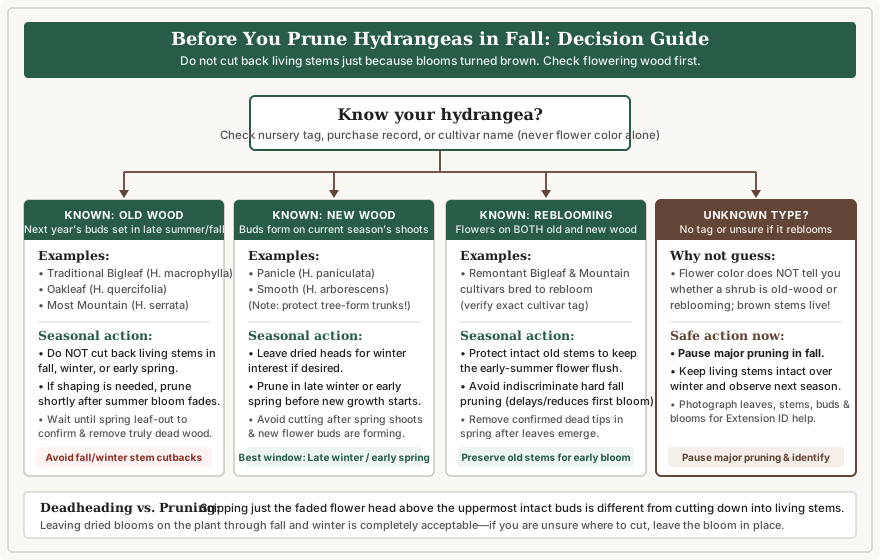
Old wood vs. new wood in plain language—and why brown stems are not dead
When gardeners talk about “when to prune hydrangeas,” everything comes down to when the shrub forms its microscopic flower buds (UMD Extension: Pruning Hydrangeas):
- Old wood means woody stems that grew during the previous summer or earlier. Traditional bigleaf, oakleaf, and most mountain hydrangeas form next year’s flower buds on these existing stems in late summer and early autumn. Those buds must survive winter on the shrub to open the following summer.
- New wood means fresh stems that push out in spring of the current growing season. Panicle and smooth hydrangeas do not carry next year’s flower buds over winter on old tips; instead, they build flower buds on new spring shoots that bloom from midsummer into autumn.
- Why brown stems and buds can fool beginners: Hydrangeas are deciduous shrubs. Once leaves drop in autumn, living old-wood stems naturally look woody, tan, or brown and peel slightly—a brown stem is dormant, not automatically dead. Furthermore, not every visible bud on a stem can be confidently identified by eye as a flower bud versus a leaf bud, so trying to prune “just above the fat flower buds” in fall often removes the real flowering wood near the stem tips.
How to identify your hydrangea (and why flower color is never enough)
Always start with the nursery tag, cultivar name, or purchase receipt if you still have it. If there is no label, compare leaf, bark, and bloom structure together—or submit clear photos of the leaves, stems, buds, and flower heads to your local Cooperative Extension diagnostic service:
- Oakleaf (H. quercifolia): Deeply lobed leaves shaped like oak leaves (often turning burgundy in fall), peeling cinnamon-tan bark on older stems, and elongated cone-shaped clusters that age from white to dusty rose-brown.
- Panicle (H. paniculata): Smaller, narrower toothed leaves (often arranged in whorls of three or opposite pairs on stiff woody stems) and pointed cone-shaped panicles that open white or lime-green in midsummer and age to pink or tan.
- Smooth (H. arborescens): Matte, heart-shaped or rounded leaves (often paler or slightly velvety underneath) with rounded dome clusters that open greenish-white to white (or pink in specific cultivars).
- Bigleaf (H. macrophylla) & Mountain (H. serrata): Thick, glossy, coarsely toothed opposite leaves (smaller and more delicate on mountain hydrangeas) with either rounded mophead globes or flat-topped lacecap rings.
Two critical identification cautions: First, leaf and flower shapes provide helpful species clues, but they do not prove whether a bigleaf or mountain cultivar is a traditional old-wood bloomer or a modern rebloomer—both can have identical glossy leaves and mophead flowers. Second, never identify pruning requirements by flower color alone. Pink, blue, and purple flowers can occur on both old-wood and reblooming bigleaf or mountain cultivars (changing with soil pH and aluminum availability), while white flowers appear across old-woodbigleaf, old-wood oakleaf, new-wood smooth, and new-wood panicle hydrangeas.
Seasonal pruning timing by growth stage—not a single calendar month
Because spring thaw, summer bloom, and autumn dormancy arrive weeks apart across US regions—and individual cultivars set buds at slightly different times—follow seasonal plant growth stages rather than a fixed calendar month (UMD Extension: Pruning Shrubs and Hedges in the Home Garden):
1. Old-wood types (Bigleaf, Oakleaf, traditional Mountain)
Healthy old-wood hydrangeas rarely need heavy annual pruning. If you need to reduce height or thin crowded oldest canes, do so soon after summer flowers fade and before late-summer flower buds develop. Once late summer and fall arrive, leave living stems uncut through winter and spring.
2. New-wood types (Panicle and Smooth)
Prune in late winter or early spring before new growth starts. Leaving dried flower heads on through autumn and winter adds garden texture and avoids stimulating tender late-season shoots before frost.
3. Reblooming (remontant) cultivars
Rebloomers flower first on old wood in early summer and again on new growth later in the season. Avoid indiscriminate hard pruning in fall or spring: cutting back living old-wood stems eliminates the first, earliest wave of flowers and delays bloom until new shoots mature. Restrict care to conservative deadheading and removing confirmed dead wood in spring, following your specific cultivar’s guidance.
What to do if your hydrangea variety is unknown
If you moved into a home with established hydrangeas or lost the plant tag and are standing in front of dried brown blooms in autumn, postpone major pruning. Keep all living stems intact through fall and winter, and simply observe how the shrub grows next season:
- Leave the woody framework and dried blooms untouched over winter.
- In spring, watch whether leaves and flower buds emerge along last year’s upright woody canes (old wood) or primarily on fresh shoots rising from the base or lower framework (new wood).
- Take clear photos of the mature leaves, flower cluster shape, and bark during early summer and share them with your county Cooperative Extension office or Master Gardener help desk for reliable identification rather than guessing.
Deadheading vs. structural pruning: where to stop if you snip dried blooms
Many fall pruning mistakes happen when a gardener sets out to tidy browned flower heads and accidentally cuts 8 to 18 inches down into the living stem. Here is the difference:
- Conservative deadheading: Snipping only the thin flower stalk (peduncle) just beneath the faded flower cluster, stopping above the first pair of healthy leaves or plump side buds on the stem. This removes the brown head without cutting into the bud-bearing wood below.
- Stem pruning: Cutting farther down into the living woody cane, which removes the upper nodes where old-wood flower buds are waiting.
- When in doubt, leave the bloom: Leaving dried hydrangea flowers on the shrub through autumn and winter is good horticultural practice—the papery heads catch frost, shelter top buds slightly, and can be snipped off in spring once green leaf buds swell clearly. If you cannot confidently locate the exact cut above living buds, leave the dried bloom in place.
Removing dead or damaged wood—and why blanket cutbacks fail
Broken, diseased, or unmistakably dead wood can be removed when spotted, but when winter dieback is uncertain, wait until spring growth begins. Dormant hydrangea stems naturally look dry and brown from November through March. Once green buds swell and leaf out in spring, truly dead stems or frost-killed tips stand out clearly above the highest living node and can be cut back cleanly without sacrificing live buds (UMD Extension).
Avoid blanket instructions to cut every hydrangea to the ground or to one fixed height: Even on new-wood types like smooth (*H. arborescens*) and panicle (*H. paniculata*) hydrangeas, cutting every stem flat to the ground can leave tall flower heads flopping in summer rain; leaving an upright framework of 18 to 24 inches on shrub-form smooth hydrangeas or thinning and shortening last season’s shoots by roughly one-third on shrub-form panicles supports sturdier stems. And on tree-form (standard) panicle hydrangeas, never cut into the trained single trunk or primary main scaffold branches—prune only the lateral shoots above the permanent crown framework (UMD Extension: Pruning Hydrangeas).
Other reasons a hydrangea produces fewer flowers (when pruning wasn’t the cause)
When a hydrangea fails to bloom, gardeners often blame themselves for pruning—even when they never touched the clippers. As University of Maryland Extension notes, several non-pruning factors commonly reduce or eliminate blooms:
- Winter cold or late-spring freeze damage: Severe winter cold, rapid autumn temperature drops, or a warm early-spring spell followed by a hard frost frequently kills exposed flower buds on old-wood bigleaf hydrangeas while the roots and lower leaf buds survive.
- Deer or rabbit browsing: Overwintering deer often nip off the plump terminal buds at the tips of hydrangea canes, removing next season’s flower buds just as effectively as pruning shears.
- Growing conditions (deep shade, drought, or excess nitrogen): Too little sunlight (such as dense tree canopy shade), summer drought stress during late-summer bud formation, or heavy high-nitrogen lawn/garden fertilizer (which pushes lush leafy stems at the expense of flower buds) can all keep an unpruned shrub from blooming.
As an Amazon Associate I earn from qualifying purchases.
FELCO F2 Bypass Pruning Shears
When bypass hand pruners are useful: When you do snip spent flower stalks or trim confirmed dead tips in spring, bypass blades (which slice past a hooked counter-blade like scissors rather than crushing woody stems against a flat anvil) make clean cuts just above a living node (UMD Extension: Pruning Shrubs and Hedges).
Optional tool—timing matters more than new shears: You do not need to buy new pruning shears to care for hydrangeas. Any clean, sharp pair of bypass hand pruners you already own is completely sufficient, and knowing whether your hydrangea blooms on old or new wood matters far more than the brand of tool in your hand.
Hydrangea Pruning Quick Guide
Includes the flowering-wood quick-reference table, identification checklist, “unknown variety” autumn rules, and space to record your cultivar and local seasonal observations. Free direct download with zero affiliate links inside the PDF.
Frequently asked questions
Can I prune hydrangeas in the fall?
Avoid cutting back living hydrangea stems in the fall. On old-wood hydrangeas (traditional bigleaf, oakleaf, and most mountain types) and reblooming cultivars, fall stem pruning removes flower buds that have already formed for next year. Even on new-wood hydrangeas (panicle and smooth types), University Extension guidance generally recommends waiting until late winter or early spring before new growth starts.
Is deadheading the same as pruning a hydrangea?
No. Deadheading removes only the faded flower cluster and its short flower stem just above the first set of intact buds, leaving the living branch intact. Pruning cuts farther down into the woody or semi-woody stem. Leaving dried flower heads on the shrub through fall and winter is also completely fine—if you are not sure where to snip, leave the dried bloom in place.
My hydrangea stems look brown and woody in late fall—are they dead?
Not necessarily. Hydrangeas are deciduous shrubs whose living stems naturally turn tan, gray, or brown as they go dormant for winter. Unless a cane is clearly broken or crumbling, wait until spring leaves emerge so you can see exactly where live growth stops before cutting out dead wood.
Can I tell how to prune my hydrangea from whether the flowers are blue, pink, or white?
No. Blue or pink flowers usually indicate a bigleaf or mountain hydrangea whose color responds to soil acidity and aluminum, but those colors cannot tell you whether the plant is a traditional old-wood variety or a modern reblooming cultivar. White blooms occur across old-wood bigleaf, oakleaf, smooth, and panicle hydrangeas—which have very different pruning needs.
I did not prune my hydrangea last fall, so why did it fail to bloom this summer?
Pruning is only one possible reason for missing flowers. On old-wood and reblooming hydrangeas, severe winter cold or a late spring frost after buds swell is a frequent culprit. Deer browsing overwintering stem tips, planting in overly deep shade, drought stress during late-summer bud formation, or applying high-nitrogen lawn fertilizer near the shrub can also reduce flowering.
Sources & Extension references
- University of Maryland Extension — Pruning Hydrangeas
- University of Maryland Extension — Pruning Shrubs and Hedges in the Home Garden