1. Immediate Answer & Realistic Expectations
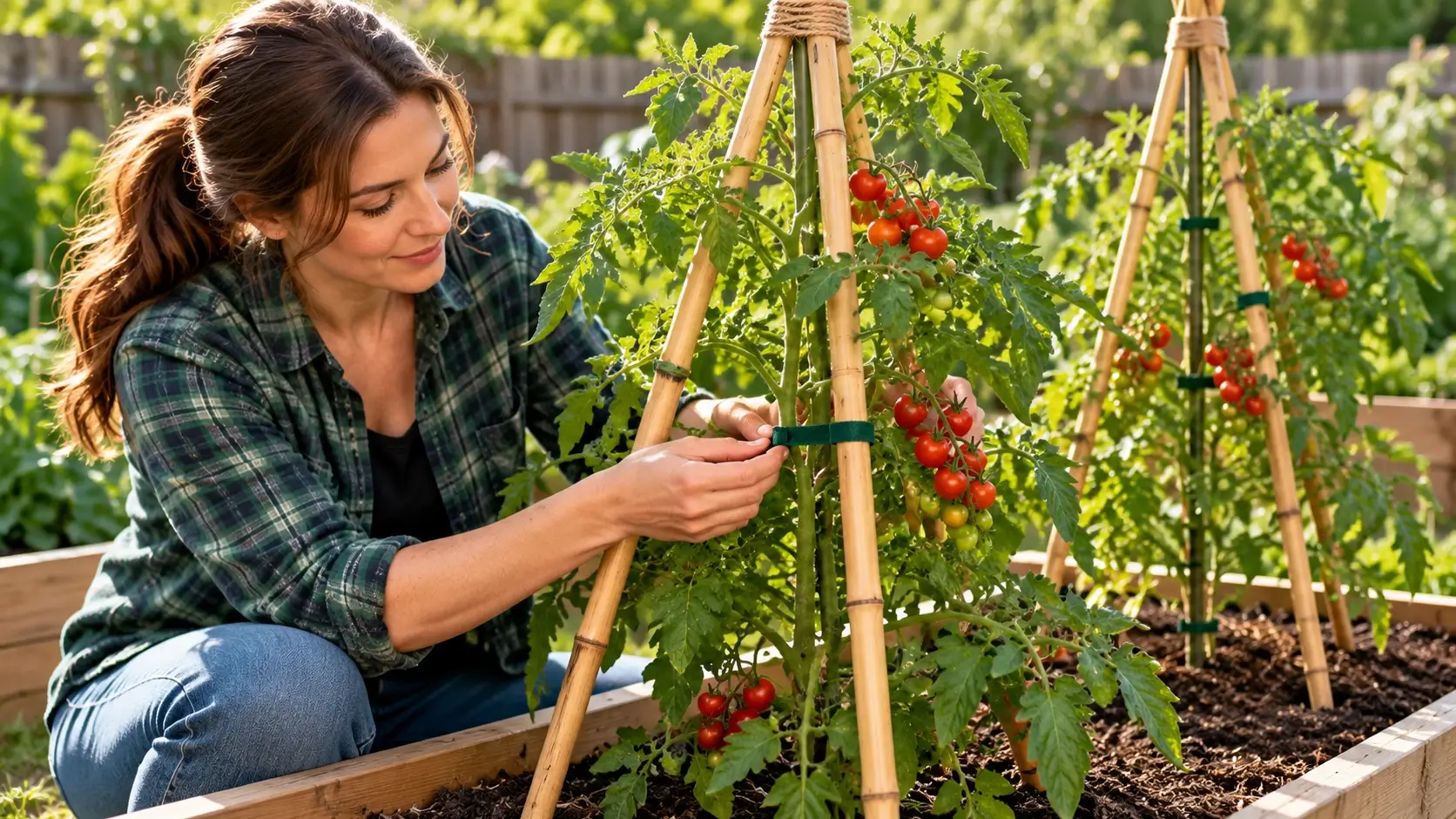
A tomato tower or three-pole tripod can organize upright growth effectively when it is sturdy, deeply anchored, sized for the cultivar’s mature height, and paired with routine tying. Install stakes at planting time so you do not damage developing roots later, give each plant adequate root and canopy space, tie stems loosely with soft ties every 6 to 8 inches of vertical growth, and adjust ties as clusters fill out (University of Minnesota Extension; Oregon State University Extension).
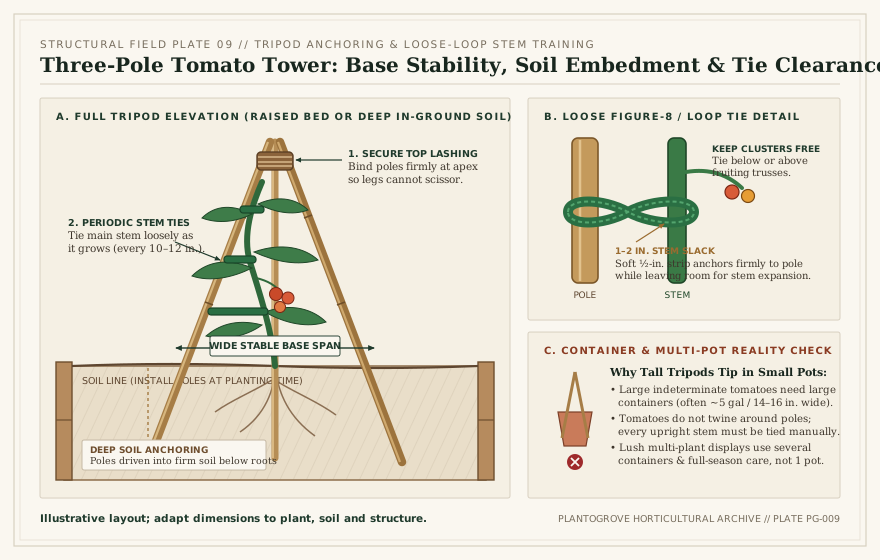
Unlike pole beans, peas, or cucumbers, tomato plants have no tendrils and do not twine or climb around stakes by themselves (UMN Extension — Trellises and Cages). If you assemble a bamboo pyramid over a young tomato and walk away, the stems will still sprawl outward or kink over the lowest bar unless you lift and tie them throughout the season.
A note on viral “before-and-after” tomato tower photos:
Social media posts frequently pair a photo of bare stakes in a bed with a second photo showing a towering wall of ripening tomatoes. When you look closely at the viral reference image, multiple plants and separate black containers appear in the mature display—not a single transplant turning into a giant hedge after a few weeks. A support structure does not automatically multiply fruit set; yield still depends on sunlight (at least 6–8 hours daily), cultivar genetics, root volume, temperature, and consistent watering.
2. What a Tomato Tower Does — and What It Does Not Do
Supporting tomatoes vertically offers real, practical advantages in home gardens and raised beds (UMN Extension — Growing Tomatoes; OSU Extension EC 1333):
- Keeps foliage and ripening fruit off damp soil: Lifting stems reduces direct contact with soil splash, mud, and ground-dwelling slugs.
- Improves light exposure and airflow: Upright training helps morning sun and breeze dry dew from leaves faster and makes it easier to spot hornworms or early leaf spots.
- Saves footprint in raised beds and small spaces: Growing upward lets you keep pathways clear and reach inner trusses at harvest time.
At the same time, it is important to be clear about what a tower cannot do:
- It does not prevent all diseases: Better airflow and less soil splash help reduce foliar pressure, but they do not make plants immune to early blight, septoria leaf spot, late blight, or soil-borne wilts.
- It does not replace root space or even moisture: Crowding four indeterminate plants under one narrow tripod in a shallow pot will still lead to water stress, flower drop, or blossom-end rot.
- Staked plants dry out faster and may show more sunscald or cracking: University of Minnesota Extension notes that staked and pruned tomatoes often produce slightly larger individual fruit, but less total yield than uncaged or caged plants with full foliage, and exposed fruit can be more vulnerable to sunscald and cracking if soil moisture fluctuates.
3. Determinate vs. Indeterminate Tomatoes: Why Growth Habit Comes First
Before buying poles or cutting bamboo, check the seed packet or nursery tag to see whether your cultivar is determinate or indeterminate (UMN Extension; University of Maryland Extension):
Determinate (“Bush”) Varieties
Grow to a compact, predetermined height—commonly 3 to 4 feet—set terminal flower clusters at the ends of shoots, and ripen their crop over a concentrated window. They still benefit from a sturdy 4–5 foot stake, short tripod, or medium cage so heavy fruit does not snap branches, but they do not need an 8-foot trellis or heavy sucker removal.
Indeterminate (“Vining”) Varieties
Continue elongating, flowering, and setting fruit along lateral shoots until frost—readily reaching 5 to 8 feet or taller in a long season. Lightweight cone cages sold at big-box stores (often 36–42 inches tall) are quickly outgrown and toppled by indeterminate vines. They require a tall 6-foot-plus stake, a wide-base tripod at least 6–7 feet tall, a heavy welded-wire cylinder, or an overhead string trellis.
4. Choosing the Right Support: Staking vs. Tripod vs. Cage vs. String Trellis
Use this comparison table to match your support structure to your tomato variety, bed layout, and willingness to tie and prune during the summer (UMN Extension; OSU Extension):
| Support Type | Best For | Main Strength | Main Limitation |
|---|---|---|---|
| Single stake | Single-leader or two-leader indeterminate plants in in-ground or deep raised beds; compact determinates with shorter stakes | Small footprint, low material cost, easy access for harvesting and inspecting leaves | Requires frequent tying (every 6–8 in.) and selective pruning; a single pole can lean in loose potting mix |
| Three-pole tripod | Raised beds or wide, heavy containers (15+ gal / half-barrel) where 1–3 leaders or cross-bars need braced stability | Three angled legs lashed at the top resist sideways tipping much better than an unbraced single pole | Apex narrows at the top where indeterminate vines are bushiest; still requires manual tying as stems grow |
| Heavy-duty cage | Bushy determinate varieties or multi-stem indeterminate plants in wide beds with minimal pruning | Supports multiple branches and heavy fruit load with less weekly tying and fuller leaf shade against sunscald | Bulky to store over winter; cheap narrow wire cones topple easily unless anchored to sturdy stakes |
| Supported string trellis | Rows of indeterminate tomatoes trained to 1–2 main stems beneath a rigid overhead frame | Excellent vertical height and airflow along a dedicated row | Requires building a strong overhead crossbar anchored by rigid end posts plus weekly stem training |
5. Raised Beds vs. Containers: Stability, Root Space, and Wind
Where you plant determines how well a tomato tower stays upright when July thunderstorms arrive:
- Raised beds offer deeper anchorage and shared root volume: In a raised bed filled with 10–12+ inches of settled soil over loosened native ground, stakes can be driven roughly 12 inches deep for solid leverage (UMN Extension). Space staked plants about 2 to 3 feet apart (and large caged or unpruned plants 3 to 4 feet apart) so roots and upper canopies do not compete for light and water (OSU Extension EC 1333).
- Containers have a high center of gravity and looser potting mix: Lightweight soilless container media does not grip a single vertical stake the way garden soil does. For standard or slicing tomatoes in containers, University of Maryland Extension recommends a minimum 5-gallon container (one plant per pot), while Oregon State University Extension notes that full-size indeterminate plants perform best in a container holding roughly 1 bushel (~8 gallons) or more (such as a 10–15 gallon tub or half-barrel).
- Wind protection for patio pots: Even in a 5–10 gallon pot, a 6-foot tomato canopy acts like a sail once upper trusses load with fruit. Choose a wide-bottomed container rather than a narrow tapered pot, set tripod legs near the outer rim down to the bottom of the pot, and place patio containers near a windbreak or low wall if your site is gusty.
6. How to Build and Anchor a Sturdy Tomato Tower Step by Step
Follow these steps at transplanting time to build a three-pole bamboo or hardwood tripod—or a braced 4-stake tower—that stays rigid through harvest:
-
1.
Check the cultivar tag for determinate vs. indeterminate growth habit
Before buying stakes or building a tripod, verify whether your tomato variety is determinate (bush-type, typically 3 to 4 feet tall) or indeterminate (vining, often 5 to 8+ feet tall). Choose poles that will stand at least 5 to 6 feet above the soil line for indeterminate varieties after the bottom 12 inches are driven into the ground.
Why it matters: Indeterminate tomatoes continue producing stems, leaves, and flower clusters until frost; a short 3-foot or 4-foot support will be outgrown by mid-summer, causing heavy upper vines to fold and kink over the top.
-
2.
Space plants properly and drive stakes at planting time
Set staked plants 2 to 3 feet apart (or 3 to 4 feet apart for broader tripods and cages) in a sunny raised bed receiving at least 6 to 8 hours of direct sun. Drive 1-inch-thick wooden stakes or heavy bamboo poles roughly 12 inches deep into firm soil about 3 to 4 inches away from the transplant root ball at planting time.
Why it matters: University of Minnesota Extension and Oregon State University Extension advise installing stakes at transplanting time because driving poles later slices through shallow lateral roots and loosens anchorage.
-
3.
Angle and lash a wide-base three-pole tripod or braced 4-stake tower
For a 3-pole tripod, space the three legs evenly in a wide triangle (18 to 24+ inches apart at the soil line in a raised bed, or near the outer rim of a wide 15+ gallon container), angle the tops together above the plant, and lash the apex tightly with figure-eight wraps of strong twine or weather-resistant straps. Add horizontal cross-ties 18 to 24 inches apart if building a 4-pole box tower.
Why it matters: A wide footprint and rigid top lashing triangulate the load so wet foliage and heavy midsummer fruit clusters cannot lever a single pole sideways in soft raised-bed or container mix.
-
4.
Tie main stems loosely every 6 to 8 inches as the plant grows
Because tomato stems do not twine or cling on their own, lift and tie the main stem(s) every 6 to 8 inches of new vertical growth. Use soft 1/2-inch hook-and-loop garden straps, cloth strips, or soft garden twine looped around the stake and stem with 1 to 2 fingers of slack—securing just beneath a main leaf node or flower truss rather than directly over blossoms.
Why it matters: Tight string or thin wire cuts into expanding stems under wind and fruit load, restricting water and vascular transport; a loose figure-eight or cushioned loop supports weight while letting the stem thicken.
-
5.
Prune conservatively based on growth habit and maintain even soil moisture
Leave determinate (bush) tomatoes largely unpruned aside from removing yellow or soil-touching bottom leaves. On staked or tripod-trained indeterminate varieties, selectively pinch small young suckers (under 2 to 4 inches) only if you are training the plant to 1 to 3 main leaders, keeping enough upper leaf canopy to shade ripening fruit from sunscald. Water deeply and consistently at soil level.
Why it matters: University of Minnesota Extension notes that staked and pruned plants dry out faster and expose fruit to more sunscald and cracking if soil moisture fluctuates, while over-pruning determinate plants removes flower-bearing shoots and reduces yield.
7. How to Tie and Train Stems Without Damaging the Plant
How you attach the stem to the pole matters just as much as the pole itself (UMN Extension; OSU Extension):
- Use wide, soft materials—never bare wire or thin monofilament: University of Minnesota Extension recommends soft garden twine, cloth strips (about 1 inch wide), old nylon stockings, or reusable soft hook-and-loop plant straps. Thin wire or tight string slices into tender green stems when wind rocks the canopy.
- Tie loosely with a 1-to-2-finger loop or figure-8 wrap: Wrap the tie firmly around the bamboo pole first so it cannot slide down the smooth cane, then loop loosely around the tomato stem—leaving 1 to 2 fingers of slack so the stem can thicken over the summer without girdling vascular flow.
- Place ties beneath a main leaf node or flower truss (not directly over blossoms): Securing just below a sturdy leaf junction or beneath a heavy fruit cluster transfers the downward weight to the stake instead of letting the pedicel kink.
- Check and add ties every 6 to 8 inches of vertical growth: Waiting until an indeterminate leader is 18 inches above its last tie invites wind snap during summer storms.
As an Amazon Associate I earn from qualifying purchases.
VELCRO Brand VEL-30071-USA ONE-WRAP Garden Ties, 50 ft x 1/2 in
Soft 1/2-inch cut-to-length hook-and-loop garden tape that wraps around stakes and tomato stems and unfastens easily when stems thicken.
Soft cotton cloth strips, old T-shirt strips, or natural jute garden twine tied in a loose loop work just as well if you already have them on hand.
8. Pruning, Airflow, Watering, and Feeding: Keep Advice Conservative
Once your plants are tied to a tower, keep ongoing care balanced rather than extreme:
- Do not aggressively prune determinate tomatoes: Because determinate (“bush”) varieties set flower clusters at shoot tips and stop growing at a fixed height, pinching out their side shoots removes the very branches that carry your harvest (UMN Extension). Limit pruning on determinates to removing damaged or soil-touching bottom leaves.
- Prune indeterminate suckers selectively—leave enough leaf canopy to shade fruit: On staked or tripod-trained indeterminate tomatoes, training to 1 to 3 main leaders by pinching small young side shoots (“suckers”, ideally under 2–4 inches long) keeps the plant manageable. However, stripping away healthy upper foliage exposes green fruit to intense afternoon sunscald (UMN Extension; OSU Extension).
- Water deeply and consistently at soil level: Upright, staked plants are more exposed to sun and drying wind than sprawling plants. Water at the base of the plant (avoiding overhead wetting of foliage late in the day) and mulch the soil surface once the ground warms to reduce moisture swings that contribute to blossom-end rot and fruit cracking.
- Avoid excessive early nitrogen: Over-fertilizing with high-nitrogen plant food early in the season drives lush, heavy vine growth that strains trellises while delaying flower set. Follow soil-test recommendations or balanced vegetable fertilizer instructions once fruit begins to set.
9. Common Tomato Tower Problems and Practical Fixes
If your support structure starts leaning or stems begin kinking mid-season, use these targeted adjustments:
| What you see | Why it happens | Practical fix |
|---|---|---|
| Tower or stake leans sideways after summer rain and wind | Poles were pushed only a few inches into loose soil, or a single stake is carrying a heavy top canopy in wet ground | Drive a heavy T-post or two angled brace stakes outside the root zone and lash the leaning tower to the new anchor; next season, drive stakes ~12 in. deep at planting time. |
| Ties keep sliding down smooth bamboo canes | Single loop around a slick cane has nothing to catch on when fruit weight pulls downward | Position the tie just above a natural bamboo node (ring) and wrap twice snugly around the cane before forming the loose loop around the stem. |
| Swollen crease or constriction where the tie meets the stem | Tie was knotted tightly against a young stem or made of thin string that cut in as the stem thickened | Cut or unfasten the tight tie immediately and replace it slightly higher or lower with a 1/2-in. soft strap or cloth strip leaving a 1–2 finger loop. |
| Indeterminate vine outgrows the narrow top of the tripod by mid-summer | Tripod legs converge at a single point where vigorous vining cultivars still have weeks of growth ahead | Lash a horizontal crossbar between two adjacent tripods to carry upper growth laterally, or top the main leader slightly above the highest support late in the season. |
| Patio container tips over on breezy afternoons | Pot is too small or light for a tall top-heavy vine when potting mix dries out between waterings | Set the pot inside a wider heavy planter or group pots against a sheltered wall, water thoroughly, and choose bush/determinate cultivars for smaller patio pots. |
10. Printable Checklist: Tomato Tower Setup & Training Checklist (PDF)
Take this 1-page worksheet to the garden shed: includes the determinate vs. indeterminate growth-habit check, raised-bed and container sizing check, stake depth & tripod anchorage checklist, loose stem-tying schedule (every 6–8 inches), storm/fruit-load inspection checklist, and a write-in Tomato Support & Training Log. Free direct download—no email signup required.
11. Frequently Asked Questions
Do tomato plants climb a tower on their own?
No. Unlike pole beans, peas, or cucumbers, tomato plants do not have tendrils and their stems do not twine around vertical poles on their own. You must manually guide the stems and secure them loosely with soft ties every 6 to 8 inches as the plant grows.
Is a bamboo tripod strong enough for indeterminate tomatoes?
A three-pole bamboo tripod can support an indeterminate tomato if you use thick, rigid canes (about 1 inch in diameter and 6 to 8 feet long), drive the legs roughly 12 inches into firm soil in a wide triangle, lash the top securely, and train the plant to 1 to 3 main stems. Thin, short 3-to-4-foot bamboo stakes will bend or tip under a full indeterminate fruit load.
How tall should a tomato trellis or stake be?
Match the height to the cultivar's growth habit. Determinate (bush) varieties usually grow 3 to 4 feet tall and do well with a 4-to-5-foot stake or cage. Indeterminate (vining) varieties commonly reach 5 to 8 feet or taller and need stakes or tower legs that stand at least 5 to 6 feet above the soil line (6 to 8 feet total length before driving 12 inches into the ground).
How tight should tomato ties be?
Tomato ties should always be loose—leave roughly 1 to 2 fingers of slack (or use a figure-eight loop where the tie crosses between the stake and stem) so the stem has room to thicken without being pinched or girdled. Use soft, wide materials such as 1/2-inch hook-and-loop garden straps, cloth strips, nylon stockings, or soft garden twine rather than thin wire.
Should I prune tomatoes on a tower?
Check whether your tomato is determinate or indeterminate first. Do not routinely prune side shoots on determinate (bush) tomatoes, because that removes fruit-bearing branches. On indeterminate (vining) tomatoes trained to a stake or tripod, you can selectively pinch small side shoots (suckers) to maintain 1 to 3 manageable main stems while leaving enough healthy leaves to shade developing fruit from sunscald.
Can I use a tomato tower in a container?
Yes, provided the container is large, wide-bottomed, and heavy enough to counterbalance the upright vine. University of Maryland Extension recommends at least a 5-gallon container for standard tomatoes, and Oregon State University Extension notes roughly a 1-bushel (~8-gallon) or larger container for full-size plants. Place container towers in a spot sheltered from strong wind gusts.
Why did my tomato tower lean or fall over?
Towers usually lean or topple because stakes were pushed only a few inches into loose soil, the base footprint was too narrow, an indeterminate vine outgrew a short support and became top-heavy with fruit after rain, or a lightweight container dried out in the wind. Anchor poles ~12 inches deep at planting time and add an angled brace stake or guy tie if heavy summer growth starts pulling the frame.
Authoritative Sources & Extension References
- University of Minnesota Extension — Trellises and cages to support garden vegetables
- University of Minnesota Extension — Growing tomatoes in home gardens
- Oregon State University Extension Service — Grow Your Own Tomatoes and Tomatillos (EC 1333)
- University of Maryland Extension — Growing Vegetables in Containers and Salad Tables
- University of New Hampshire Extension — Tips for Small Space Gardening: Pots and Other Containers (Note: direct automated fetch returned HTTP 404 during editorial verification; container sizing and small-space support recommendations are cross-checked against the verified University of Maryland Extension and Oregon State University Extension publications above.)