
The direct answer
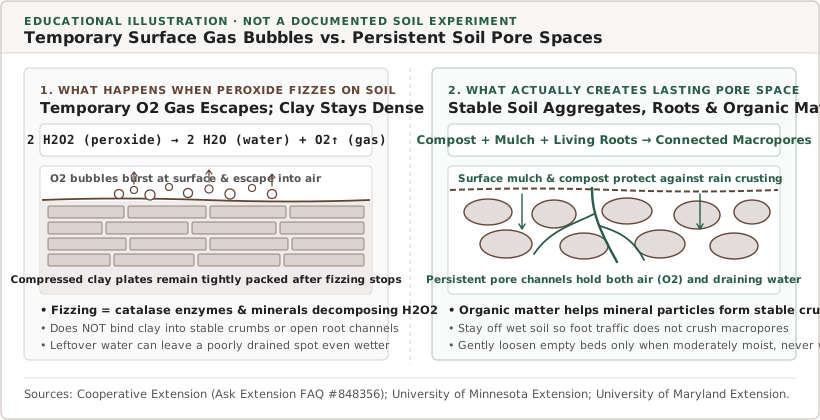
No—household hydrogen peroxide is not an established solution for mechanically loosening compacted clay or compacted garden soil. When hydrogen peroxide contacts soil, enzymes and mineral surfaces rapidly break it down into water and oxygen gas. That brief surface fizzing shows a chemical decomposition reaction taking place, not mineral particles being pushed apart into stable, root-friendly soil aggregates.
Once the gas escapes into the air and the liquid settles, compressed soil particles remain packed together. Lasting soil structure comes from organic matter, living roots, soil biology, and protecting wet ground from foot or equipment traffic (Ask Extension FAQ #848356).
Why soil fizzes when hydrogen peroxide touches it
A molecule of hydrogen peroxide (H2O2) has one more oxygen atom than a molecule of water (H2O)—not an extra oxygen molecule (O2). When it contacts catalase enzymes in organic matter or reactive iron and manganese oxides on soil minerals, it rapidly breaks down:
Why bubbles do not prove lasting pore space, improved drainage, or root-rot recovery
- Bubbles do not build persistent pore space: As University of Minnesota Extension explains, compaction squeezes soil particles together and destroys large macropores. Escaping oxygen gas bubbles do not bind clay plates into durable crumbs.
- Peroxide does not fix restricted drainage: Once the brief reaction finishes, the remaining liquid is simply water.
- It is not a selective cure for root rot: Hydrogen peroxide is a non-selective oxidizer that does not distinguish between plant pathogens, beneficial microbes, or fine root hairs (Ask Extension FAQ #848356).
Four different problems that look alike: surface crust, compaction, clay texture, and waterlogging
Check with a trowel to distinguish a thin dry surface crust, deeper soil compaction, natural clay texture, and waterlogging (University of Maryland Extension). Remember that yellow leaves alone do not diagnose root rot—yellowing foliage can reflect underwatering, nutrient shortages, cold soil, or natural leaf aging as well as wet soil.
Practical alternatives that build real soil structure
-
1. Keep foot traffic off beds and never work wet soil
Stay off wet soil and use dedicated paths so footprints and wheelbarrows never compress growing areas (UMN Extension).
-
2. Add finished compost and keep the surface mulched
Apply 1 to 2 inches of finished compost and 2 to 3 inches of organic mulch. Avoid blanket recommendations to add sand or gypsum to clay soil (UMD Extension).
-
3. Careful fork use in an empty bed vs. surface improvement around established roots
In an empty, moderately moist bed, you can gently loosen compacted layers with a digging fork. Around established plants, never pry in the root zone; top-dress with compost and mulch instead.
Optional Hand Tool · Empty-Bed Preparation As an Amazon Associate I earn from qualifying purchases.Radius Garden 203 PRO Garden Stainless Steel Digging Fork, Green
How it fits empty-bed prep: Rigid square stainless-steel tines let you fracture a compacted layer or work finished compost into the top few inches of an unplanted, moderately moist bed. A suitable existing digging or spading fork can also be used.
Important caution: Digging around established roots or working wet soil can cause damage.
-
4. Address chronic drainage bottlenecks or use raised beds
Redirect downspout runoff or build a raised bed filled with a well-drained soil-and-compost mix where native drainage is restricted (UMD Extension: Soil to Fill Raised Beds).
Compacted Garden Soil Checks
Free direct download—no email signup required and zero affiliate links inside the PDF.
Frequently asked questions
Why does garden soil fizz when you pour hydrogen peroxide on it?
Soil contains organic matter, living microbes, plant roots, and minerals like iron and manganese oxides. Catalase enzymes and mineral surfaces trigger the breakdown of hydrogen peroxide into water and oxygen gas (2 H2O2 → 2 H2O + O2). The bubbles simply show oxygen gas escaping—not soil particles being loosened.
Does hydrogen peroxide have an extra oxygen molecule compared to water?
No. A molecule of hydrogen peroxide (H2O2) has one more oxygen atom than a molecule of water (H2O), not an extra oxygen molecule (O2). Two molecules of H2O2 must break down to release one molecule of O2 gas.
Can hydrogen peroxide fix waterlogged or poorly draining clay soil?
No. Once the brief fizzing stops, the remaining liquid is ordinary water, and the heavy clay particles settle right back where they were. Improving drainage requires organic matter, protecting soil structure from wet traffic, redirecting surface runoff, or building raised beds.
Do yellow leaves on my garden plants mean they have root rot and need peroxide?
No. Yellow leaves (chlorosis) can be caused by underwatering, nitrogen or iron deficiency, cold soil, transplant shock, natural aging of lower leaves, or overly wet soil. Always check soil moisture 3 to 4 inches deep and inspect root health before assuming root rot.
Should I mix sand or gypsum into compacted clay soil to loosen it?
Avoid blanket applications of sand or gypsum. Mixing moderate amounts of sand into clay fills pore spaces around sand grains with sticky clay, creating a denser, brick-like soil. Gypsum mainly improves structure in sodic (high-sodium) soils rather than typical eastern or midwestern clay gardens; finished compost and organic mulch are far more reliable.
Sources & Extension references
- Cooperative Extension (Ask Extension) — Ask Extension FAQ #848356: Hydrogen Peroxide Use in Garden Soils and Plants
- University of Minnesota Extension — Soil Compaction: Causes, Pore Space Effects, and Prevention
- University of Maryland Extension — Soil Health, Drainage, and Improving Soil
- University of Maryland Extension — Soil to Fill Raised Beds