
The short answer
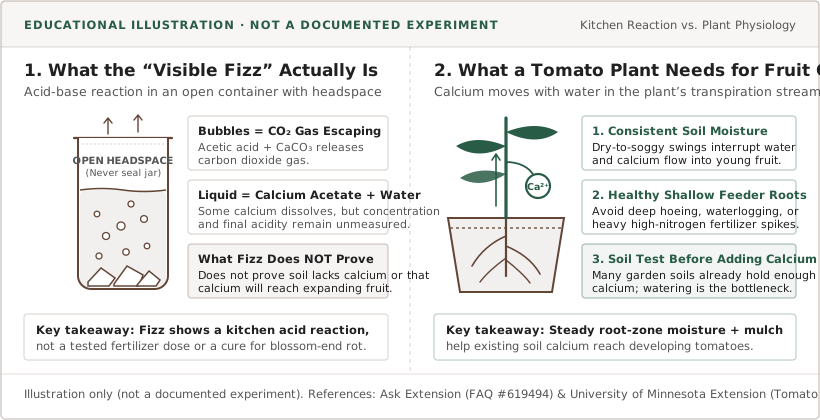
Dissolving eggshells in vinegar is a genuine acid-base reaction, but visible fizzing does not make the mixture a proven blossom-end-rot treatment or a balanced tomato fertilizer. When household vinegar (dilute acetic acid) touches eggshell calcium carbonate, it releases carbon dioxide gas and forms dissolved calcium acetate and water. However, most home-garden blossom-end rot happens because inconsistent soil moisture, root stress, or heavy fertilization disrupts water and calcium movement into rapidly expanding fruit—not because the soil has zero calcium.
Your tomato plants will not die without this kitchen hack, and no soil drench or spray can repair dark, sunken spots on fruit that is already damaged. Before adding any amendment, check soil moisture consistency, drainage, root health, and a soil test.
Why eggshells fizz in vinegar: the kitchen chemistry
Dry chicken eggshells are composed mostly of calcium carbonate (CaCO3), the same mineral found in agricultural limestone and chalk, bound together by a thin protein matrix and inner membrane. Ordinary household white vinegar is typically 5% acetic acid (CH3COOH) in water.
Those rising bubbles are carbon dioxide gas escaping from the liquid in an open container with generous headspace—never use a sealed jar, because released carbon dioxide gas builds pressure inside closed vessels.
Why bubbling does not prove you have a balanced fertilizer
- Extraction is neither instant nor guaranteed complete: Household vinegar is a weak, dilute acid; large shell fragments often remain largely intact after initial fizzing slows.
- Unreacted vinegar remains acidic: Pouring an unverified vinegar solution around roots can temporarily lower root-zone pH and injure tender feeder roots.
- It is not a proven blossom-end-rot treatment: University Extension specialists note that homemade eggshell-and-vinegar mixtures have no verified garden application rate and do not fix the underlying water-transport disruption (Ask Extension FAQ #619494).
Why plain eggshell breakdown in garden soil varies
There is no single universal two-year countdown clock for eggshells in soil. Breakdown varies depending on particle size (coarse shards weather far more slowly than finely ground powder), soil pH (calcium carbonate dissolves faster in acidic soils than in neutral or alkaline soils), and soil moisture and biological activity (Ask Extension).
Calcium in the soil versus calcium reaching developing fruit
As University of Minnesota Extension explains, blossom-end rot is a physiological disorder caused by a local calcium shortage in the rapidly expanding distal end of the fruit. Calcium moves upward with the water-conducting xylem stream driven by transpiration. Because leaves transpire far more water than waxy young fruit—and calcium is not redistributed from leaves to fruit via the phloem—foliar sprays and unverified homemade drenches do not solve fruit calcium delivery.
Five practical checks before buying or applying anything
-
1. Check root-zone soil moisture consistency
Swings between dry soil and sudden heavy drenching are the single most common trigger for blossom-end rot. Check moisture 2 to 4 inches below the surface rather than judging by the dry top crust alone (UMN Extension).
Optional Field Tool · Soil Moisture Check As an Amazon Associate I earn from qualifying purchases.XLUX Soil Moisture Meter
Practical benefit: Lets you check moisture deeper in a tomato container or raised bed in seconds so you can catch dry pockets before the plant wilts.
Limitation: Gives a relative moisture indication only—it does not measure calcium, pH, or dissolved nutrients, and it does not replace a laboratory soil test.
-
2. Verify drainage and mulch the soil surface
Make sure containers have clear drainage holes and apply 2 to 3 inches of organic mulch to reduce rapid surface evaporation.
-
3. Protect shallow feeder roots around the stem
Avoid deep hoeing or digging close to tomato stems where shallow feeder roots absorb water and calcium (UMN Extension).
-
4. Avoid excessive nitrogen or high-salt fertilization
Heavy nitrogen or ammonium fertilizers spur rapid leaf growth that outcompetes young fruit for the water-and-calcium stream.
-
5. Run a laboratory soil test before adding calcium
Submit a soil sample through your state Cooperative Extension lab to check soil pH and extractable calcium before adding lime or gypsum (Ask Extension).
Tomato Moisture & Blossom-End-Rot Checks
Free direct download—no email signup required and zero affiliate links inside the PDF.
Frequently asked questions
Why do eggshells fizz when you put them in vinegar?
Eggshells are made mostly of calcium carbonate. When placed in household vinegar (dilute acetic acid), an acid-base reaction releases carbon dioxide gas—the bubbles you see—while forming dissolved calcium acetate and water.
Does eggshell-and-vinegar water cure blossom-end rot on tomatoes?
No. It cannot repair fruit that already has dark, sunken blossom-end rot spots, and bubbling in a jar does not address the most common cause of blossom-end rot in home gardens: fluctuating soil moisture that interrupts water and calcium flow into young fruit.
Do plain crushed eggshells always take exactly two years to break down in soil?
No. There is no single universal timeline. Breakdown speed depends on how finely the shells are ground, soil pH (acidic soils dissolve calcium carbonate faster than neutral or alkaline soils), and soil moisture.
Should I spray vinegar-and-eggshell liquid on tomato leaves or fruit?
No. University Extension guidance notes that foliar calcium sprays do not effectively move calcium from leaves into developing fruit, and household vinegar solutions can burn foliage.
Sources & Extension references
- Cooperative Extension (Ask Extension) — Eggshells and Vinegar: Calcium Availability, Soil pH, and Blossom-End Rot (FAQ #619494)
- University of Minnesota Extension — Tomato Disorders: Blossom-End Rot, Water Transport, and Cultural Management